 Aspirational
Category
Articles
Every articles on Aspirational Guide.

Airport Jobs Across Nigeria Are Open — See Requirements and Current Vacancies
Airport work in Nigeria covers far more than airline jobs: ground handling, check-in, aviation security screening, cargo, terminal retail and catering, cleaning, engineering support and station admin. Most roles are on-site, shift-based, tied to one airport, and require a background check before an airside pass is issued.
9 min read

Top Industries for High-Paying Jobs at Home and Overseas
The best-paid work in the US clusters in a few areas — healthcare practitioners and technical roles, legal, sales, skilled installation and maintenance, production, and arts, design and media — and several of those groups are among the ones BLS names as more likely to have telework available (U.S. Bureau of Labor Statistics, 2022). "Overseas" pay usually means one of two things: a US employer paying you while you work abroad, or a foreign employer hiring you onto a local or expatriate package with different tax and benefit rules.
9 min read

Remote and work-from-home jobs are hiring now across dozens of industries in 2026!
Remote and hybrid roles are posted across customer support, sales, healthcare administration, software, accounting, education and logistics. Most are ordinary jobs with an ordinary hiring process — remote changes where you sit, not whether you have to prove you can do the work.
8 min read

High-paying jobs are available right now across dozens of fields — many starting above $70,000 a year!
Headlines like this one describe a market, not an offer. There are US occupations — licensed healthcare, skilled trades, technology, logistics, specialised sales, regulated office work and government — where pay sits well above the national median, but what any single job pays depends on the occupation, your state and metro area, your licences, shift and overtime rules, and whether the employer publishes a pay band at all.
9 min read

Entry-level jobs in 2026 span warehouses, offices, and remote desks — find the one that fits you.
Entry-level hiring in the US splits roughly into three settings: physical work in warehouses and stockrooms, desk work in offices and call centers, and that same desk work done from home. Most of these roles ask for little or no formal credential and train you on the job, so the real decision is about shifts, setting and what your body and schedule can sustain.
10 min read

Full/Part-Time Career Opportunities that offer attractive pay & benefits
"Full-time" and "part-time" describe how many hours you usually work, not a kind of job. In US federal statistics, workers count as full-time if they usually work 35 or more hours a week and part-time if they usually work fewer (U.S. Bureau of Labor Statistics, undated) — but the same agency says those definitions are statistical only and are not legal definitions (U.S. Bureau of Labor Statistics, undated). Your employer sets its own hours threshold for benefits, and that is the number that affects you.
9 min read

Government and federal jobs offer competitive salaries, pension plans, and career security in 2026!
Government work in the United States spans thousands of occupations across hundreds of agencies, and most of it is filled through one public process rather than private recruiters. Federal agencies use USAJOBS to post announcements and match qualified applicants to jobs, and it is the central place to find work in hundreds of federal agencies and organizations (U.S. Office of Personnel Management (OPM), undated).
9 min read

Las oportunidades de empleo en Estados Unidos te están esperando.
En agosto de 2025 la economía estadounidense tenía 7,2 millones de vacantes abiertas, una tasa del 4,3 por ciento (U.S. Bureau of Labor Statistics, 2025-09-30). Eso no significa que haya un puesto con tu nombre esperándote: significa que hay movimiento constante y que quien busca de forma organizada aparece antes en la lista que quien manda currículums sueltos.
8 min read

Remote Jobs in the US 2026: What to Expect and How to Start
Of people at work in 2024, 22.8 percent teleworked or worked at home for pay at some point, including 10.9 percent who did so for all their hours (U.S. Bureau of Labor Statistics, 2025-09-05). So remote work going into 2026 is normal but still a minority pattern: genuine openings exist, alongside a much larger pool of on-site jobs and a growing volume of fake postings.
9 min read

US Job Openings in 2026: Growing Industries and How to Apply
The U.S. economy is projected to add 5.2 million jobs from 2024 to 2034, with total employment rising to 175.2 million (U.S. Bureau of Labor Statistics, 2025-08-28). That growth is uneven: healthcare and in-home care, security and data work in computing, and parts of the energy sector are expanding, while retail trade is projected to lose the most jobs of any sector as automation and e-commerce reshape store-based sales roles (U.S. Bureau of Labor Statistics, 2024-08-29).
9 min read

Career opportunities across the USA offer rewarding benefits.
Work in the United States ranges from hourly shift jobs to salaried office roles and fully remote contracts. The benefits attached to a job — health coverage, paid time off, retirement contributions — are set by the employer and vary widely by state, sector, and whether you are full-time, part-time or on contract.
8 min read

Explore job openings across America's growing industries
"Growing industries" in the United States mostly means health care and social assistance, computing and IT, utilities and clean energy, and transportation and warehousing. The U.S. Bureau of Labor Statistics projects the economy will add 6.7 million jobs from 2023 to 2033, with health care and social assistance the largest and fastest growing sector (U.S. Bureau of Labor Statistics, 2024-08-29). Openings in these fields are posted in ordinary places: employer career pages, state workforce agency job banks, staffing agencies and general job boards.
8 min read
Breaking Into Remote Customer Support Work in the UK
Remote customer support means handling a company's customer questions by phone, email, live chat or social media from home rather than from a contact centre floor. In the UK it is one of the more accessible remote entry points: most employers weigh communication skills and reliability above formal qualifications, though they still expect a quiet space, a stable connection and set hours.
8 min read
Finding Work in the UK: What Job Seekers Should Know Before Starting
Finding work in the UK usually comes down to three things: proving you are allowed to work here, getting your paperwork in order, and applying where employers actually post vacancies. Most entry-level and mid-level hiring happens through a small set of job boards, agencies and employers' own websites, and pay is normally quoted as an hourly rate or an annual salary before tax.
10 min read
Breaking Into UK Healthcare: Job Roles, Earnings Info and Application Tips
UK healthcare hiring runs through two broad doors: regulated clinical roles that require registration with a professional body before you can practise, and support or non-clinical roles that usually require a background check, induction training and a willingness to work shifts. This guide covers what the work looks like day to day, which employers recruit, how pay tends to be structured, and the checks worth doing before you accept anything.
8 min read
UK Warehouse Careers: A Day-to-Day Look and How to Get Started
Warehouse work in the UK covers picking, packing, loading, stock control and goods-in checks. It is on-site, usually on a fixed or rotating shift pattern that may include nights and weekends, and most entry-level roles ask for no formal qualifications — employers screen on right to work, reliability and whether you can hold a pace target for a full shift.
7 min read
Working a Skilled Trade in the UK: Compensation and Getting Started
Skilled trades in the UK — electrical, plumbing and heating, carpentry, bricklaying, welding, HVAC, vehicle repair and similar — are hands-on, site- or workshop-based jobs you enter through an apprenticeship, a college course plus on-the-job hours, or by labouring while you train. Pay is usually an hourly rate, a day rate or an annual salary, and it shifts with your trade, your cards and registrations, whether you are employed or self-employed, and where in the UK you work.
9 min read
Explorez des emplois bien rémunérés faits pour vous
Les offres présentées comme « bien rémunérées » aux États-Unis couvrent des réalités très différentes : métiers techniques, logistique, santé, service client à distance, postes spécialisés en entreprise. Ce guide explique ce que ces emplois demandent au quotidien, quels types d'employeurs recrutent, comment la paie est construite et quelles vérifications faire avant de signer.
9 min read
Découvrez dès maintenant des emplois à salaire attractif
Les annonces promettant un « salaire attractif » couvrent en réalité des métiers très différents : logistique, santé, centres de contact, métiers techniques, postes administratifs à distance. Ce guide explique à quoi ressemble ce type de travail au quotidien aux États-Unis, quels employeurs recrutent réellement, comment la rémunération est construite et comment vérifier une offre avant de l'accepter.
9 min read

Truck Driving in Australia: How Drivers Get Paid and Hired
Truck driving in Australia is licensed work, and the licence class you hold — light rigid up to multi-combination — decides which jobs you can realistically apply for. Most drivers are hired directly by transport and distribution operators or through labour-hire agencies, and pay is set by a federal award, an enterprise agreement, or a per-kilometre or per-trip contract rather than by one national rate.
9 min read
Working in Healthcare in Australia: Roles and Pay Explained
Healthcare is one of Australia's largest employment sectors, covering public hospitals run by state and territory health departments, private hospital groups, GP and allied health clinics, aged care, disability support and community services. Some roles require national registration with Ahpra; many support, administrative and assistant roles do not.
9 min read
What Skilled Trade Workers Earn in Australia and How to Start
Skilled trades in Australia — electrical, plumbing, carpentry, fabrication and more — are usually entered through a paid apprenticeship attached to a nationally recognised qualification, not a university degree. Most trade licences require a relevant Certificate III or IV plus a completed apprenticeship of three to four years (TradieVerify, undated), and pay during that time is typically set as a rising percentage of a qualified tradesperson's rate under a modern award.
11 min read
Inside Australia's Mining Industry: What Job Seekers Should Know
Australian mining employs people across open-cut and underground sites, processing plants, workshops, camps and city-based offices, with much of the on-site work run on fly-in fly-out or drive-in drive-out rosters. Entry points range from unskilled labour and traineeships to licensed trades, plant operation, geology and engineering, and most roles sit under an enterprise agreement or an award that sets the pay framework.
12 min read
High Paying Jobs in Australia You Can Pursue Now
The best-paid work in Australia clusters in a few places: resources and mining, skilled trades and construction, heavy transport, healthcare, and technical roles in engineering, data and software. Most pay well because of a licence, a ticket, a registration or a roster that other people can't or won't take on — not because of the job title.
8 min read

How to Switch From Marketing to UX Design
Switching from marketing to UX design usually takes six to twelve months of part-time retraining while you keep working, and the thing that gets you hired is a portfolio of two or three end-to-end case studies rather than a certificate on its own. The U.S. Bureau of Labor Statistics notes that workers in this occupation "may not need specific education credentials if they can demonstrate their abilities through prior work experience or projects" (U.S. Bureau of Labor Statistics, 2025), which is the opening most marketers use.
Junie Castellane · 16 min read

How to Restart a Stalled Job Search: Steps (With Scripts)
Restart a stalled job search by stopping applications for about a week, auditing where your last 20 to 30 went dead, and rebuilding the plan around direct contact with people rather than job-board volume. Most of the work is in the first two weeks: a cleaned-up target list, a short outreach script, and a standing weekly quota of conversations.
James O'Connor · 13 min read

Group Interview Tips: 8 Ways to Stand Out When Interviewing With Others
A group interview puts two or more candidates in the same room for the same job, and the interviewers watch how you interact with the others as well as listening to your answers (UConn Center for Career Readiness and Life Skills, 2022). This guide gives you eight concrete things to do — before you walk in, while the room is running, and in the 24 hours after — so you come across as the person the team would want in the room every week.
Priya Nathwani · 12 min read

How to Become a Freelancer (Steps, Skills and Pay)
To become a freelancer, you pick a service you can already do to a paid standard, register as a business, set up contracts and bookkeeping, then find clients and keep finding them. Most people start part-time alongside a job and move across once two or three repeat clients cover their bills.
Marisol Andrade · 14 min read

The PAR Method: How to Answer Behavioral Questions (+ Examples)
The PAR method gives you a repeatable shape for any question about your past work: state the problem or project, describe the action you took, then finish with the result. Learn it once and you can answer "tell me about a time when..." questions without rambling, trailing off, or realising halfway through that you have forgotten how the story ended.
Theo Lindqvist · 21 min read

How Long Does It Take to Become a Pharmacy Technician?
Becoming a pharmacy technician usually takes somewhere between a few months and two years. The short route is a high school diploma plus on-the-job training under a pharmacist; the longer route is a postsecondary pharmacy technology program, which can run from a few months up to an associate degree (U.S. Bureau of Labor Statistics, 2020). ONET classifies the job as Job Zone Three, where employees usually need one or two years of combined on-the-job experience and informal training (ONET OnLine, 2026).
Theo Lindqvist · 13 min read

How to List Certifications on a Resume (+ Examples)
List each certification as its own line in this order: certification title, awarding organization, date earned, and the skills it proves where that helps (Indeed, undated). Most resumes put a dedicated, clearly headed certifications section after education, in reverse chronological order, with the issuer, date and credential ID or verification link on each entry (Jobscan, undated; MentorCruise, undated).
Ananya Rao · 13 min read

How to Switch From a Staffing Agency Job to Direct Employment
Moving from a staffing agency assignment to a direct W-2 job with the client usually happens one of two ways: the client converts you onto their own payroll, or you use the assignment as evidence and apply directly somewhere else. Both start with the same work — proving what you did, finding out who controls the headcount, and checking what your agency contract says about conversion fees and non-solicitation.
Wei Chen · 14 min read

20 Resume Keywords by Field to Pass an ATS Scan
Use the keywords that actually appear in the job ad you are answering, in the posting's own wording, and back each one with a bullet that has a number in it. CareerOneStop advises that because applicant tracking software is so common in U.S. hiring, a resume should use exact terms from the job posting, since any variation may fail to be recognized as a qualification (CareerOneStop, undated).
Nadia Hassan · 13 min read

How to Become an HVAC Technician (Steps, Skills and Pay)
Most HVAC technicians get in one of two ways: a trade school or community college program in heating, air conditioning and refrigeration, which generally runs 6 months to 2 years and leads to a certificate or associate's degree, or a registered apprenticeship that pays you while you train over several years (U.S. Bureau of Labor Statistics, 2025). Either route, you need EPA Section 608 certification before you can work unsupervised on equipment containing refrigerant, and you should expect long-term on-the-job training once you are hired (U.S. Bureau of Labor Statistics, 2025).
Marisol Andrade · 15 min read

10 Free Certifications That Boost Your Resume
The free certifications that actually move a resume are the ones employers name in their own job postings: analytics and advertising platform credentials, cloud and security fundamentals, spreadsheet and SQL basics, CRM badges, and the short safety or compliance cards that some states and employers fund. Each takes anywhere from an afternoon to a few weekends, and each is only as persuasive as the work you can show next to it.
Ananya Rao · 12 min read

Paralegal Without a Degree: How to Get Started
You can become a paralegal without a degree, but it is the slower of the two routes. The U.S. Bureau of Labor Statistics (2025) reports that paralegals and legal assistants typically need an associate's degree or a certificate in paralegal studies, that some employers prefer a bachelor's degree, and that others will consider a high school diploma plus relevant experience — and some employers hire candidates with no legal education at all and train them on the job (U.S. Bureau of Labor Statistics, 2025).
Desmond Okafor · 14 min read

How to List Freelance and Gig Work on a Resume
Freelance, contract and gig work belongs in your work history like any other job: a job title that describes what you actually did, the word "(Freelance)" or "(Contract)" after it, real start and end dates, and bullets that show scope. The decisions that take thought are how to group a long client list, how much to say about part-time hours, and which small gigs to leave off entirely.
Priya Shah · 13 min read

Administrative Assistant Resume Examples & Writing Guide
An administrative assistant resume works when it shows scope: how many calendars you run, how many calls or invoices you handle, which systems you work in, and who you support. Below is a complete mid-level sample and a shorter entry-level version, followed by section-by-section instructions, weak-versus-strong bullet pairs, a skills table, and where to check current pay.
Desmond Okafor · 18 min read

How to Become a Temp Worker (Steps, Skills and Pay)
You become a temp worker by registering with one or more staffing agencies, passing their screening (usually ID and work-eligibility paperwork, references, sometimes a background check or skills test), and accepting short assignments at the agency's client companies. Most entry-level temp work — warehouse, clerical, hospitality, call centre — needs no degree and no prior experience, and many people are working within one to three weeks of registering.
Theo Lindqvist · 12 min read

How Long Does It Take to Become a Plumber?
Plan on about four to five years from your first day as an apprentice to working independently as a licensed journey-level plumber. Most plumbers learn the trade through a 4- or 5-year apprenticeship with roughly 2,000 hours of paid on-the-job training plus classroom instruction each year, and most states require a license before you can work on your own (U.S. Bureau of Labor Statistics, 2025).
Priya Nathwani · 14 min read

Career Change at 40: Where to Start
Start by narrowing the field before you spend a dollar: write down the tasks you want more of, pick two or three target job titles, talk to people already doing them, and only then commit to a credential with a fixed end date. Most changes at 40 take somewhere between six and eighteen months from first research to first day in the new role, and the biggest single variable is whether the job needs a state license.
Ananya Rao · 14 min read

10 Questions to Ask Before Accepting a Job Offer
Before you accept, you need answers to ten things: what the whole package is worth, what the work actually is, how you will be judged, who you report to, and what the written offer does and does not say. Most of these are easy to ask while the offer is open and nearly impossible to fix after you sign.
Priya Shah · 14 min read

How to Answer "What Is Your Greatest Strength?" (+ Example Answers)
"What is your greatest strength?" is a fit question. The answer that works names one strength the job description asks for, backs it with a short, specific story from your own experience, and ends with what changed because of it.
Wei Chen · 10 min read

Warehouse Worker Resume Example (+ Template)
A warehouse resume works when a hiring manager can tell, in ten seconds, what you moved, how fast, on what equipment, and whether you are certified to run it. Below is a complete mid-level sample you can copy, a shorter entry-level version, and the formulas behind every line of both.
Priya Nathwani · 18 min read

12 AI Skills Job Seekers Need to Learn Right Now
The AI skills worth learning first are the ones you can show in a work sample: briefing a model properly, checking what it gives back, and wiring it into a real task someone pays for. Everything below can be built on your own time with free or low-cost tools, and most items take days or weeks rather than months.
Theo Lindqvist · 13 min read

12 Certifications That Lead to IT Support Jobs
No certification hires you, but a handful are named often enough in help desk, desktop support and field technician postings that holding one gets your resume read by a human. The twelve below are ranked by how directly they map to first-line support work and how widely they are recognized across employers, rather than by how advanced they are.
Olu Adeyemi · 13 min read

Career Change at 30: How to Start Over Without Losing Momentum
Changing careers at 30 usually takes six to twelve months of deliberate work, not a clean break. Most of that time goes on three things: confirming the new role actually matches what you want day to day, closing the one or two concrete gaps employers screen for, and translating eight to ten years of experience into the new field's language.
Nadia Hassan · 15 min read

How to Switch From Retail to Healthcare
You can usually move from a retail floor into a frontline healthcare support job inside a year, because the common entry roles — nursing assistant, medical assistant, pharmacy technician, phlebotomist — are built on short certificate programs or employer training rather than degrees. What stands between you and the first shift is state rules, clinical hours you have to attend in person, and a stretch where you are paying tuition while working fewer retail hours.
Desmond Okafor · 16 min read

Nursing Interview Questions and How to Answer Them
By the end of this guide you will know how a nursing interview is usually structured, which competencies each round is testing, and how to turn your own shifts into answers that hold up under follow-up questions. It covers the questions asked of almost every registered nurse, the ones specific to bedside practice, and sample answers you can adapt.
James O'Connor · 20 min read

How to Answer "Why Do You Want to Leave Your Current Job?" (+ Example Answers)
When an interviewer asks why you want to leave your current job, they want a reason that is forward-looking, specific and consistent with the rest of your story. The strongest answers name something you want to do more of, explain why your current role cannot offer it, and connect that to the job on the table — in about 30 to 60 seconds.
Marisol Andrade · 11 min read

Military to Civilian Career Change: How to Translate Your Skills
Translating military experience into civilian work is mostly a language and timing problem, not a qualifications problem. You take what you already did — leading people, maintaining equipment, moving supplies, running comms — restate it in the vocabulary of a civilian job family, then add one credential or one block of civilian work experience that proves the claim to a stranger.
James O'Connor · 16 min read

10 Questions to Ask a Hiring Manager
By the end of this guide you will have ten questions you can take into an interview, in the order you would actually ask them, plus a sense of which ones to drop when time runs short. Most interviewers ask whether you have any questions, and CareerOneStop, the U.S. Department of Labor's career site, recommends having some ready to show interest in the role and the company (U.S. Department of Labor / CareerOneStop, undated).
Desmond Okafor · 9 min read

How to Become a Pharmacy Technician (Steps, Skills and Pay)
To become a pharmacy technician you usually need a high school diploma or equivalent, registration or licensure with your state board of pharmacy, and in most cases a national certification such as the PTCB's CPhT. Training comes either from a formal program of a few months to a year, or from on-the-job training at a retail chain or hospital, depending on what your state allows.
Daniel Ortiz · 13 min read

Resume Margins, Font and Spacing Guide
Set page margins between 0.5 and 1 inch on all four sides, body text at 10–12 pt in a common serif or sans-serif face, and line spacing at 1.0 to 1.15. That combination reads cleanly on a screen, prints without clipping, and survives the text extraction that applicant tracking systems run on your file before a human ever opens it.
Daniel Ortiz · 16 min read

How Far Back Should a Resume Go?
For most US resumes, go back 10 to 15 years in full detail and compress anything older into a single early-career line or leave it off. The test is relevance, not age: keep an older role only if it carries the licence, industry, employer scale or technical depth the posting asks for.
Olu Adeyemi · 13 min read

How to Negotiate a Sign-On Bonus: Steps (With Scripts)
A sign-on bonus is a one-time payment for joining, and the time to ask for one is after you have a written offer and before you accept it. It is often the easiest part of an offer to move, because it does not raise the employer's ongoing payroll cost — but it usually comes with a service commitment and a repayment clause if you leave early.
Priya Nathwani · 14 min read

How to Write a Resume Work Experience Section (+ Examples)
Write your work experience section in reverse-chronological order, and give every job the same four-part heading — job title, organization, city and state, and employment dates — followed by bullets that each start with an action verb and end with a number or a scope. CareerOneStop, which is sponsored by the U.S. Department of Labor, calls this usually the most critical part of a resume, because it is where you show the tasks and accomplishments that connect to the job you want (undated).
Junie Castellane · 14 min read

How to Decline a Job Offer Professionally: Steps (With Scripts)
Decline a job offer by telling the person who extended it — the recruiter or hiring manager — as soon as you are certain, then confirming in writing the same day. Thank them, say no clearly, give one short reason, and stop there. The goal is a clean answer the employer can act on, with your name intact at that company for the next opening.
Priya Shah · 12 min read

Best Careers for Introverts
The best careers for introverts are not the ones with no people in them — they are the ones where the work itself is solitary and the social contact is scheduled, predictable and purposeful. Roles like bookkeeping, data analysis, technical writing, medical coding, software testing and CAD drafting put long stretches of concentration at the centre of the day and keep contact with others mostly to written updates and a handful of planned meetings.
Junie Castellane · 16 min read

What to Say When You Get Ghosted After a Job Interview
When an employer goes quiet after an interview, say something short, specific and low-pressure: thank the person you met, restate one concrete reason you fit the role, and ask directly when a decision is expected. One well-timed email to the recruiter or hiring manager does more than three vague check-ins, and a clear "if the timing has changed, just tell me" makes it easy for them to reply with bad news instead of nothing.
Nadia Hassan · 12 min read

What to Say When You're Overqualified for a Job in an Interview
Say plainly why this role fits what you want now, then answer the worry sitting underneath the word rather than the word itself. The concerns behind "overqualified" are usually that you will expect more money, get bored, leave for a bigger job, or bristle at reporting to someone with less experience (EBR HR Experts, undated).
Daniel Ortiz · 12 min read

10 Best Careers for Introverts
The best careers for introverts are the ones where most of the day is spent on one task you control, contact with other people is scheduled rather than constant, and you can prove your ability with work samples instead of a network. That describes software development, data analysis, technical writing, accounting, security analysis, lab science, archives work, design, paralegal work and sonography — ten fields with clear entry routes and steady demand across most of the US.
Sofia Bauer · 13 min read

How to Ask for a Letter of Recommendation: Steps (With Scripts)
Ask in conversation first, then follow up the same week with a written request that contains everything the person needs: your current resume, what the letter is for, the skills and achievements you want mentioned, the due date and exactly where the letter goes. Indeed's recommended process starts with building a referral list of qualified people, speaking to each one to confirm they're willing and available, and only then sending the formal request (Indeed, undated).
Olu Adeyemi · 14 min read

What to Say When a Recruiter Asks Why You Left Your Last Job
Answer with one true reason, stated in a single sentence, then connect it to the job you are interviewing for. One common framework suggests acknowledging something positive about the old role, giving the reason, linking it to the new opportunity, and keeping the whole thing under 60 seconds (Status.net, undated).
Marcus Lee · 12 min read

10 Jobs That Let You Work Outdoors
If you want work that happens outside, the realistic routes in are seasonal grounds and parks crews, entry-level construction and tree work, guiding and field technician jobs, and skilled trades like solar installation and land surveying. Most start with a short certification, a seasonal hire, or a physical test rather than a degree.
Marisol Andrade · 14 min read

12 Job Search Mistakes That Are Costing You Interviews
If you are applying steadily and hearing nothing, the problem is usually at the screening stage, not in your experience. Most lost interviews come from a handful of repeatable habits: a resume that does not show the minimum qualifications fast, applications sent only through job boards, formatting that software cannot read, and follow-up that never happens.
Marcus Lee · 14 min read

Best Careers for People Who Love Working With Their Hands
If you want work where the result is physical and the day ends with something finished, the strongest options are the licensed building trades — electrical, plumbing and pipefitting, HVAC — plus welding and fabrication. Most of these are entered through an apprenticeship that pays you while you train, or through a short technical program, not a four-year degree.
Wei Chen · 15 min read

How Long Does It Take to Become a Phlebotomist?
For most people, becoming a phlebotomist takes a few months to a year. Certificate programs at community colleges, vocational schools and technical schools usually take less than a year and cover anatomy, physiology, medical terminology and lab work (U.S. Bureau of Labor Statistics), and some employers hire candidates with only a high school diploma and train them on the job (U.S. Bureau of Labor Statistics).
Sofia Bauer · 13 min read

Military to Civilian Resume: How to Translate Your Experience
A military-to-civilian resume is the same resume as anyone else's, written in words a hiring manager already uses. You keep the scope, the numbers and the responsibility; you drop the acronyms, the rank-only titles and the regulation citations, and you give each job a civilian title the reader can match to the posting.
Sofia Bauer · 15 min read

15 Hard Skills Employers Want on a Resume
Hard skills are the teachable, measurable abilities you gain through education, training or hands-on work — software, equipment, languages, methods, licences — as opposed to soft skills, which are personality traits that are harder to quantify (Resume Genius, undated). The 15 below are the ones that turn up again and again in US job ads across office, tech, healthcare, trades and creative work.
Marcus Lee · 13 min read
How To Find Job Opportunities In The United States In 2026
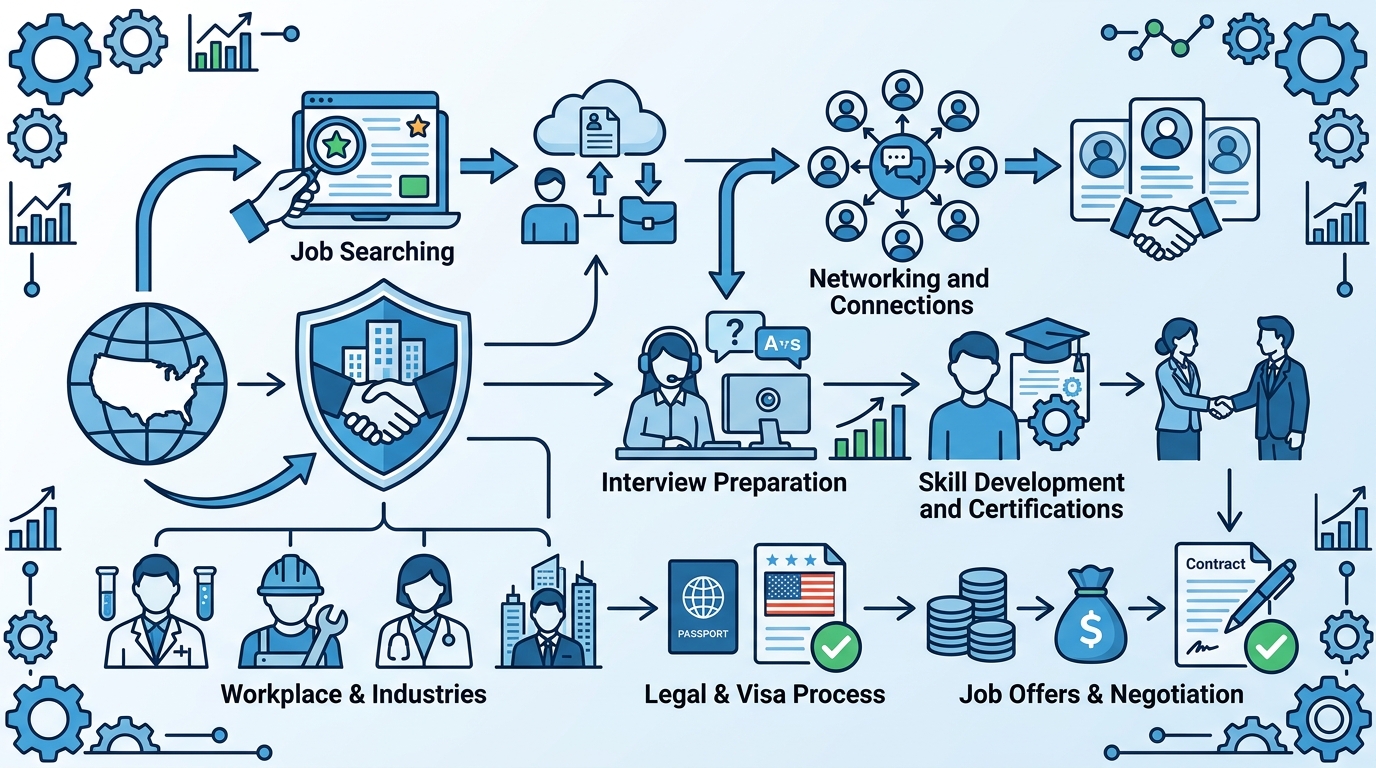
Finding work in the United States in 2026 comes down to three things: searching the places where openings are actually posted, understanding how an employer structures pay before you negotiate, and checking that the offer in front of you is real. Public guidance points job seekers to CareerOneStop, their state's job bank and the American Job Center database, with USAJOBS as the central place for federal jobs (USAGov (U.S. General Services Administration), 2026-08-05).
Marisol Andrade · 9 min read