 Aspirational
Warehouse Worker Resume Example (+ Template)
A one-page layout for pickers, packers, loaders and forklift operators, with bullets written in cases, pallets and pick rates, not vague duties.
By Priya Nathwani · Published · Updated · 18 min read
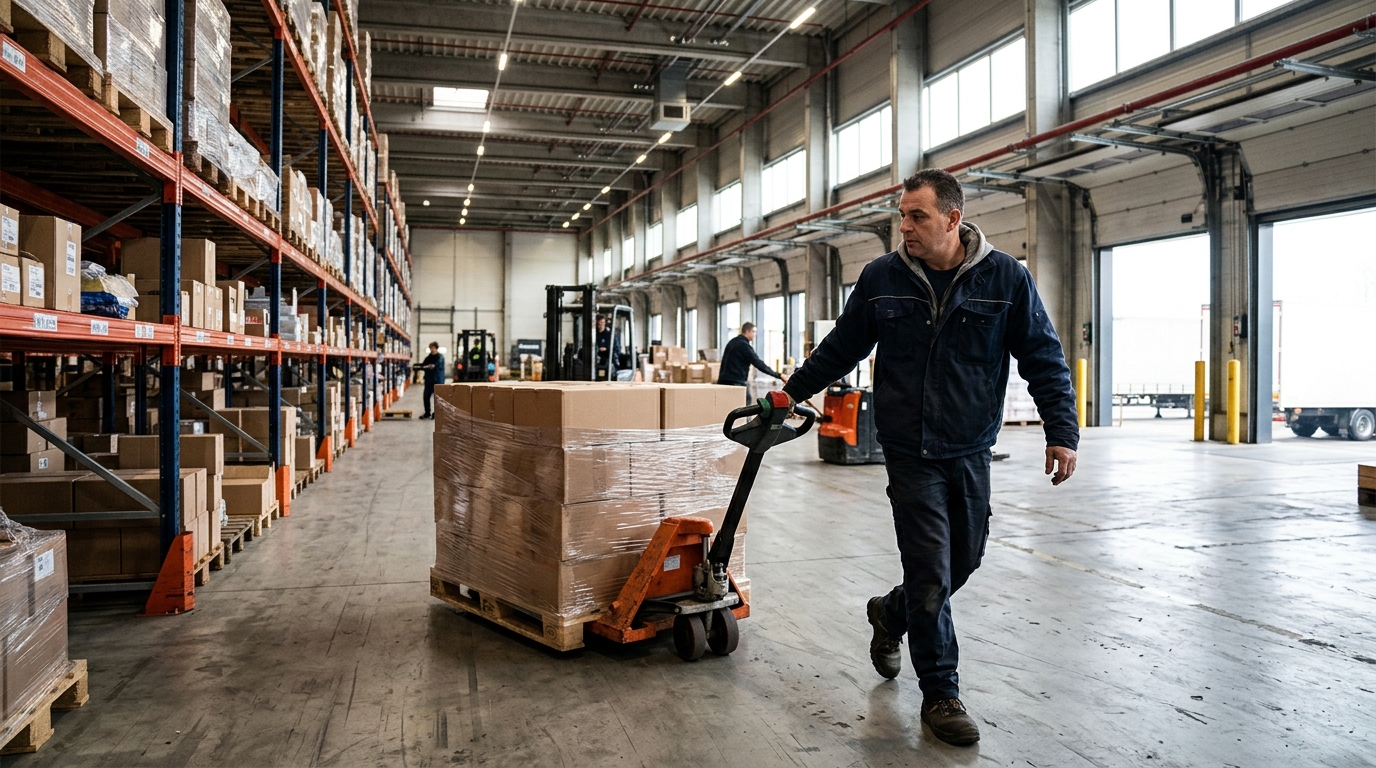
A warehouse resume works when a hiring manager can tell, in ten seconds, what you moved, how fast, on what equipment, and whether you are certified to run it. Below is a complete mid-level sample you can copy, a shorter entry-level version, and the formulas behind every line of both.
Swap the example numbers for your own. Figures like cases per shift, lines per hour and pallets loaded are there to show the shape of a strong bullet, not to set a standard you have to match.
Sample resume
The job title on most postings is some mix of warehouse associate, material handler, picker/packer, loader or order selector. Federal occupation data files all of these under 'Laborers and Freight, Stock, and Material Movers, Hand,' SOC code 53-7062.00 (ONET OnLine, U.S. Department of Labor, undated), and the core task is moving freight, stock or other materials to and from storage or production areas, loading docks, delivery vehicles, ships or containers, by hand or with equipment (ONET OnLine, U.S. Department of Labor, undated). Your resume should make that movement measurable.
Mid-level sample: warehouse associate with six years' experience
Warehouse associate / forklift operator — one page
MARCUS DELGADO Columbus, OH 43215 | (614) 555-0142 | marcus.delgado@email.com
WAREHOUSE ASSOCIATE — POWERED INDUSTRIAL TRUCK CERTIFIED
Warehouse associate with 6 years in high-volume distribution across receiving, RF picking and outbound loading. Certified on sit-down counterbalance, reach truck and electric pallet jack. Picks 130–150 lines per hour at 99.6% accuracy across 4,000 active SKUs and trains seasonal hires each peak.
EXPERIENCE
Warehouse Associate II, Shipping — [Third-party logistics distribution center], Columbus, OH March 2022 – Present
- Load and strap 18–22 outbound trailers per shift on a sit-down counterbalance forklift, averaging 26 pallets per trailer, with no load-shift damage claims in 14 months. - Scan and verify 900–1,200 cases per shift against bills of lading on an RF handheld, holding outbound accuracy at 99.8%. - Run weekly cycle counts on 300 pick slots, reconcile variances in the WMS and cut repeat short-picks on the top 50 SKUs. - Train 11 seasonal hires each peak season on dock safety, pallet jack handling and RF scanning; 8 converted to permanent roles. - Lead 5-minute pre-shift hazard and stretch talks for a 24-person crew and log near-miss reports for the site safety committee.
Forklift Operator / Order Picker — [Regional grocery distribution center], Grove City, OH August 2020 – March 2022
- Picked 130–150 lines per hour on voice-directed and RF orders across 4,000 SKUs at 99.6% accuracy on 10-hour shifts. - Operated reach truck and order picker to let down and replenish 80+ pallets per shift from racking up to 30 feet. - Shrink-wrapped, labeled and staged 60–75 outbound pallets per shift for LTL and parcel carriers. - Quarantined damaged freight and completed OS&D paperwork on roughly 15 shipments per month, reducing carrier credit disputes.
Material Handler — [Food manufacturing plant], Columbus, OH June 2019 – August 2020
- Unloaded floor-stacked containers by hand, moving 1,100–1,400 cases per shift at weights up to 50 lb. - Sorted inbound freight to 12 putaway zones and recorded receipts in the WMS within 30 minutes of door close. - Maintained housekeeping and dock-plate checks on 3 dock doors; passed two unannounced internal safety audits with no findings.
SKILLS
RF handheld and ring scanners | WMS receiving, putaway and cycle-count transactions | Sit-down counterbalance forklift | Reach truck | Electric and manual pallet jack | Order picker | Trailer loading and load securement | Voice picking | Shrink wrapping and palletizing | OS&D reporting | Bills of lading and packing slips | Basic Excel shift reporting
EDUCATION
High School Diploma — [Public high school], Columbus, OH, 2019
LICENCES AND CERTIFICATIONS
- Powered Industrial Truck Operator certification, employer-issued under 29 CFR 1910.178(l) — sit-down counterbalance, reach truck, electric pallet jack; last performance evaluation 2024 - OSHA 10-Hour General Industry card - First Aid / CPR / AED - DOT hazardous materials handling awareness training
Entry-level variant: no warehouse history yet
Same structure, shorter. The summary states availability and physical capability instead of pick rates, and the experience section uses whatever work you have done — retail stock, kitchen, landscaping, moving, construction labor — translated into weight, volume and pace.
Entry-level warehouse worker — one page
JORDAN PIKE Dayton, OH 45402 | (937) 555-0188 | jordan.pike@email.com
WAREHOUSE ASSOCIATE — ENTRY LEVEL
Stock and general labor background with 2 years of lifting, sorting and inventory work. Comfortable on feet for 10-hour shifts, lifting 50 lb repeatedly, and available for nights and weekends. Completed forklift operator training; seeking a role with employer certification and evaluation on site.
EXPERIENCE
Seasonal Warehouse Helper — [Staffing agency], assigned to a parcel sortation site, Dayton, OH October 2024 – January 2025
- Unloaded and sorted 900–1,100 parcels per shift from trailers to belt lines during peak season. - Scanned packages on an RF handheld and re-labeled misrouted freight, clearing 30–40 exceptions per shift. - Kept 4 chute lanes clear and reported 2 blocked-egress hazards that were corrected the same night.
Stock Associate — [Home improvement retailer], Dayton, OH March 2023 – September 2024
- Received and put away 20–30 pallets per overnight shift using a manual pallet jack. - Cycle-counted 150 bin locations per week and corrected count variances in the store inventory system. - Broke down and baled cardboard from 25+ pallets nightly and staged returns for carrier pickup.
SKILLS
RF handheld scanning | Manual pallet jack | Pallet building and shrink wrapping | Cycle counting | Safe lifting and team lifts | Reading pick tickets and packing slips | Basic inventory systems | Nights, weekends and overtime availability
EDUCATION
High School Diploma — [Public high school], Dayton, OH, 2022
CERTIFICATIONS AND TRAINING
- Forklift operator training course (classroom and practical), 2025 — awaiting employer evaluation and certification - OSHA 10-Hour General Industry card, 2024
How to write each section
Build the page in this order. Keep it to 1 page unless you have more than 10 years of warehouse history; use 10–12 pt body text, 0.5–1 inch margins, and a name at 16–20 pt. Save as PDF unless the posting or the staffing agency asks for a .docx, and name the file Firstname-Lastname-Warehouse-Resume.pdf.
1. Header
Five items on two or three lines:
- Full name, as it appears on your ID
- City and state (plus ZIP if you want to signal a short commute) — no full street address
- One phone number you answer, with voicemail set up
- A plain email address
- Optional: a one-line target title such as WAREHOUSE ASSOCIATE — FORKLIFT CERTIFIED
Skip photos, graphics, columns, icons and skill rating bars. Many warehouse applications are typed into a kiosk or an applicant portal that strips formatting, and a two-column layout can scramble on the way through.
2. Summary
Three sentences, maximum four lines. Use this formula:
[Job title] with [X years] in [type of facility: distribution, cold storage, manufacturing, parcel, 3PL], covering [two or three functions]. Certified on [equipment]. [One measurable result in cases, pallets, lines or accuracy].
Example — experienced
Warehouse associate with 6 years in high-volume distribution across receiving, RF picking and outbound loading. Certified on sit-down counterbalance, reach truck and electric pallet jack. Picks 130–150 lines per hour at 99.6% accuracy across 4,000 active SKUs.
Example — entry level
Stock and general labor background with 2 years of lifting, sorting and inventory work. Comfortable lifting 50 lb repeatedly across 10-hour shifts and available for nights, weekends and overtime. Completed classroom and practical forklift training; seeking employer certification on site.
3. Experience
List jobs newest first. For each: job title, employer type and city/state, month and year started, month and year ended. Gaps are normal in this work — seasonal contracts end, plants shut lines — so date honestly and do not hide a staffing agency assignment. Name the agency as your employer and note the type of site you were assigned to.
Use 3–5 bullets per job, each 1–2 lines, each following this formula:
Action verb + what you moved or checked + scope in your own units (cases, pallets, trailers, lines, SKUs, bin locations, lb) + outcome or standard.
Useful verbs: loaded, unloaded, picked, packed, staged, palletized, wrapped, scanned, sorted, replenished, cycle-counted, reconciled, audited, trained, operated, inspected.
Example bullets to adapt:
- Unloaded 1,100–1,400 cases per shift from floor-stacked containers at weights up to 50 lb.
- Picked 130–150 lines per hour by RF and voice across 4,000 SKUs at 99.6% accuracy.
- Loaded 18–22 outbound trailers per shift and secured loads with straps and load bars, with no damage claims in 14 months.
- Replenished 80+ pallets per shift from racking up to 30 feet on a reach truck.
- Cycle-counted 300 pick slots per week and reconciled variances in the WMS the same shift.
- Packed and labeled 400–500 parcels per shift to carrier specifications, keeping mislabels under 3 per week.
- Processed 25–35 customer returns per shift, grading stock as resellable, repack or scrap.
- Completed OS&D reports on roughly 15 damaged or short shipments per month.
- Trained 11 seasonal hires on dock safety, pallet jack handling and RF scanning.
- Performed pre-shift equipment inspections on 4 lift trucks and tagged out 2 units for hydraulic leaks.
If you do not know your exact numbers, estimate from something you can count: trailer doors per shift, pallets per trailer, cases per pallet, orders per hour on the shift board. Give a range rather than a false precise figure.
4. Skills
One block of 10–14 items separated by pipes, or two short columns if the rest of the page is single-column. Lead with equipment and systems, then process skills. Only list equipment you can actually be evaluated on tomorrow — in a working interview, somebody may hand you the keys.
5. Education
Two lines at most: credential, school, city and state, year. Federal data lists no formal educational credential as the typical entry-level education for this occupation (U.S. Bureau of Labor Statistics, 2025), and survey respondents report that some jobs require a high school diploma or equivalent, some require less, and some require some college with no degree (ONET OnLine, U.S. Department of Labor, undated). The occupation sits in Job Zone 1-2, 'Very Little to Some Preparation Needed' (ONET OnLine, U.S. Department of Labor, undated). So list a diploma or GED if you have one, list your highest completed level if you do not, and never leave the section off entirely. If you are mid-way through a program, write 'in progress' with the expected date.
6. Licences and certifications
This section often decides who gets called. Put it near the top of page one if your forklift certification is current and the posting asks for it.
List items worth naming:
- Powered industrial truck (forklift) operator certification — name the truck classes you were evaluated on: sit-down counterbalance, stand-up reach, order picker, electric pallet jack, clamp truck
- OSHA 10-Hour or 30-Hour General Industry card
- First Aid / CPR / AED
- Hazardous materials handling training
- Lockout/tagout, fall protection or aerial lift training, if the site used it
- A valid driver's licence, if the role includes yard moves or box truck work
One point on forklift certification that candidates get wrong: it is issued by an employer, not bought as a lifelong card. Only trained and competent operators may run a powered industrial truck, and operators must be trained and certified by their organization under 29 CFR 1910.178(l) (Occupational Safety and Health Administration, undated). That training must combine formal instruction, practical training and an evaluation of performance in the workplace (Occupational Safety and Health Administration, undated). Employers must certify the training and re-evaluate each operator at least once every three years, with refresher training whenever an operator shows a deficiency in safe operation (Occupational Safety and Health Administration, undated).
So write it as: 'Powered industrial truck operator certification, employer-issued under 29 CFR 1910.178(l) — sit-down counterbalance and reach truck; last evaluation 2024.' That tells a hiring manager exactly what re-evaluation they need to run, instead of leaving them guessing.
Weak vs strong bullets
The pattern in every pair below is the same: name the equipment, add the unit, add the standard you held.
Weak
Responsible for loading trucks and making sure freight was secure.
Strong
Loaded and strapped 18–22 outbound trailers per shift on a sit-down counterbalance forklift, averaging 26 pallets per trailer, with no load-shift damage claims in 14 months.
The weak version could describe one trailer a week. The strong version gives volume, equipment and a damage record, which is the number dock supervisors actually track.
Weak
Picked orders accurately and efficiently in a fast-paced warehouse.
Strong
Picked 130–150 lines per hour by RF and voice across 4,000 SKUs at 99.6% accuracy on 10-hour shifts.
'Accurately and efficiently' is the claim; lines per hour and an accuracy percentage are the evidence. If your site measured units or cases per hour instead of lines, use that unit — it tells the reader what kind of building you came from.
Weak
Used a forklift on a daily basis.
Strong
Operated stand-up reach truck and order picker to let down and replenish 80+ pallets per shift from racking up to 30 feet; certified and evaluated on both classes under 29 CFR 1910.178(l).
Truck class and rack height matter. An operator who has only run a walkie in a flat warehouse is a different hire from one who works at 30 feet, and a vague bullet makes the manager assume the smaller of the two.
Weak
Helped with inventory counts and fixed any mistakes.
Strong
Cycle-counted 300 pick slots per week, reconciled variances in the WMS the same shift and cut repeat short-picks on the top 50 SKUs.
Inventory accuracy is one of the few places a floor associate visibly saves money. Say how many locations, how often, and in what system.
Skills to include
Pick 10–14 of these that you can prove, and make sure each one also appears inside an experience bullet. A skills list that is not backed up anywhere else on the page reads as a wish list.
| Skill | Hard or soft | How to show it on the resume |
|---|---|---|
| Powered industrial truck operation | Hard | Name the classes — sit-down counterbalance, stand-up reach, order picker, electric pallet jack — and the rack height you worked to |
| RF handheld and ring scanning | Hard | Tie it to volume: cases scanned per shift, exceptions cleared, accuracy held |
| WMS transactions | Hard | List the transaction types you ran: receiving, putaway, replenishment, cycle count, cancel/reship |
| Trailer loading and load securement | Hard | Trailers per shift, pallets per trailer, straps and load bars used, damage claims avoided |
| Order picking and packing | Hard | Lines, units or cases per hour and the accuracy rate your site measured |
| Cycle counting and inventory reconciliation | Hard | Locations counted per week and what happened to the variances |
| Shipping paperwork — BOLs, packing slips, OS&D | Hard | Number of shipments checked or OS&D reports filed per month |
| Physical strength and stamina | Soft | State the lift weight and shift length plainly, e.g. lifting to 50 lb across 10-hour shifts; exerting force to lift, push, pull or carry is listed as a key ability for this occupation (O*NET OnLine, U.S. Department of Labor, undated) |
| Safety and housekeeping discipline | Soft | Audits passed, near-misses reported, pre-shift equipment inspections completed |
| Training and mentoring new hires | Soft | How many seasonal or new associates you trained, and on what |
| Shift flexibility | Soft | One line in the summary: nights, weekends, overtime, peak season — schedules in this work often include nights and weekends (U.S. Bureau of Labor Statistics, 2025) |
| Basic spreadsheet reporting | Hard | Name what you built: shift production logs, count sheets, damage trackers |
Leave off generic filler like 'good communication' and 'strong work ethic' unless you can attach a number or an example to it. The space is better spent on one more piece of equipment.
Pay and outlook
Pay for warehouse work is almost always hourly, and the posted rate is only part of it. What moves the number:
- Shift. Nights, weekends and third shift usually carry a differential on top of base rate. Most workers in this occupation are full time, although part-time work is common and schedules vary, including nights and weekends (U.S. Bureau of Labor Statistics, 2025).
- Equipment and certification. Sites commonly pay more for certified operators on reach trucks, order pickers and clamp trucks than for floor-level picking or hand unloading.
- Environment. Cold storage, freezer and hazardous materials sites often pay a premium over ambient dry goods warehousing.
- Employment route. Direct-hire, temp-to-hire through a staffing agency, and union-represented facilities each structure pay and raises differently. Agency assignments sometimes convert to a different rate on hire — ask what the conversion rate is before you accept.
- Incentives. Some buildings run production or attendance bonuses, peak-season premiums and overtime at volume; others do not. Ask how performance is measured and whether it changes pay.
- Location. Rates vary widely by state and metro area, and even between two buildings in the same city on different highways.
For current figures, go to the official source rather than a job board average. The U.S. Bureau of Labor Statistics publishes a median annual wage for hand laborers and material movers — the most recent one is for May 2025 (U.S. Bureau of Labor Statistics, 2025). Look up the occupation in the Occupational Outlook Handbook for the national picture, then use the BLS Occupational Employment and Wage Statistics program for state and metropolitan-area figures, which is where the real spread shows.
On demand: hand laborers and material movers manually move freight, stock and other materials (U.S. Bureau of Labor Statistics, undated), and they work in stockrooms, warehouses, manufacturing plants and other settings (U.S. Bureau of Labor Statistics, 2025). Overall employment is projected to grow from 2025 to 2035, about as fast as the average for all occupations (U.S. Bureau of Labor Statistics, 2025). BLS also projects openings each year over that decade, largely from the need to replace workers who transfer to other occupations or leave the labor force (U.S. Bureau of Labor Statistics, 2025) — which is the practical point for a job seeker: turnover keeps doors open even where headcount is flat.
Entry is not gated by schooling. Typical entry-level education is no formal educational credential, and workers typically learn through on-the-job training lasting one month or less (U.S. Bureau of Labor Statistics, 2025). That cuts both ways: it is a realistic field to enter without a degree, and it means your resume has to compete on equipment, certification and measurable output rather than credentials.
Related guides
Next steps on the same application:
- Warehouse Worker Cover Letter Example (+ Template)
- Warehouse Worker Interview Questions and Answers
- How to Explain Employment Gaps on a Warehouse Resume
- Resume Formatting Checklist for Applicant Tracking Systems
Neighbouring roles, both listed by federal occupation data as related to Laborers and Freight, Stock, and Material Movers, Hand (O*NET OnLine, U.S. Department of Labor, undated):
- Forklift Operator Resume Example (+ Template) — Industrial Truck and Tractor Operators, SOC 53-7051.00
- Packer and Packager Resume Example (+ Template) — Packers and Packagers, Hand, SOC 53-7064.00
Other moves from the warehouse floor:
- Shipping and Receiving Clerk Resume Example
- Inventory Control Clerk Resume Example
- Warehouse Supervisor Resume Example
- Delivery Driver Resume Example
Frequently asked questions
What do I put on a warehouse resume with no experience?
Use the entry-level structure above and translate the physical work you have already done. Retail stock, grocery, kitchen, landscaping, construction labor, moving, farm work and military logistics all involve lifting, sorting, counting and pace — write those in weight, volume and shift length. Then add the three things a warehouse hiring manager scans for: availability (nights, weekends, overtime, peak season), safe lifting capability stated plainly, and any training you hold such as an OSHA 10-Hour card or a completed forklift course. If you have no paid history at all, list school, volunteer, sports or family business work with real numbers attached, and say in the summary that you are seeking on-the-job training and employer evaluation. That is a reasonable ask: typical entry-level education for this occupation is no formal educational credential, and training usually lasts one month or less on the job (U.S. Bureau of Labor Statistics, 2025).
What format and file type should I use?
A single-column, reverse-chronological layout: header, summary, experience, skills, education, licences and certifications. Body text at 10–12 pt, margins between 0.5 and 1 inch, name at 16–20 pt, bullets no longer than 2 lines each. No columns, tables, graphics, headshots or skill bars — warehouse applications frequently go through kiosk portals and agency systems that strip or scramble them. Send a PDF unless the posting or recruiter asks for a Word file, and name it with your name and the role. Keep a plain-text copy on your phone too, because many warehouse applications are typed into a form on site and you will be pasting each bullet in by hand.
How long should a warehouse worker resume be?
One page. That covers almost everyone in this field, including six to ten years across several sites. Go to two pages only if you have more than 10 years of relevant history with supervisory or equipment-heavy responsibility worth detailing, and never pad to fill a second page. Detail the last 10 years in full bullets; older jobs can be a single line each with title, employer type and dates, or dropped if they add nothing. If you have held many short agency assignments, group them under the agency as one employer with the assignments listed beneath, so the page does not look like a dozen separate jobs.
Should I list a forklift certification from an old employer?
Yes — list it, and be precise about it. Write the truck classes you were evaluated on, the year of your last evaluation, and that it was employer-issued. Certification comes from the organization you worked for, not from a card you own permanently: operators must be trained and certified by their employer under 29 CFR 1910.178(l), and employers must re-evaluate each operator's performance at least once every three years (Occupational Safety and Health Administration, undated). A new employer will run its own evaluation regardless, but showing documented formal instruction, practical training and a workplace evaluation (Occupational Safety and Health Administration, undated) tells them you need a check-ride, not a full course. If your last evaluation is more than three years old, still list it and add 'refresher required' rather than quietly dropping it.
Sources
- U.S. Bureau of Labor Statistics — Hand Laborers and Material Movers : Occupational Outlook Handbook
- O*NET OnLine (U.S. Department of Labor) — 53-7062.00 - Laborers and Freight, Stock, and Material Movers, Hand

Written by
Priya Nathwani
Priya writes about the unglamorous parts of work: onboarding, performance reviews, the group chat that decides who gets promoted. She's happiest untangling office politics into something useful.