Aspirational
How to Become a Pharmacy Technician (Steps, Skills and Pay)
Most states require registration or licensure, and most employers want certification — here is what the training, testing and first job actually involve.
By Daniel Ortiz · Published · Updated · 13 min read
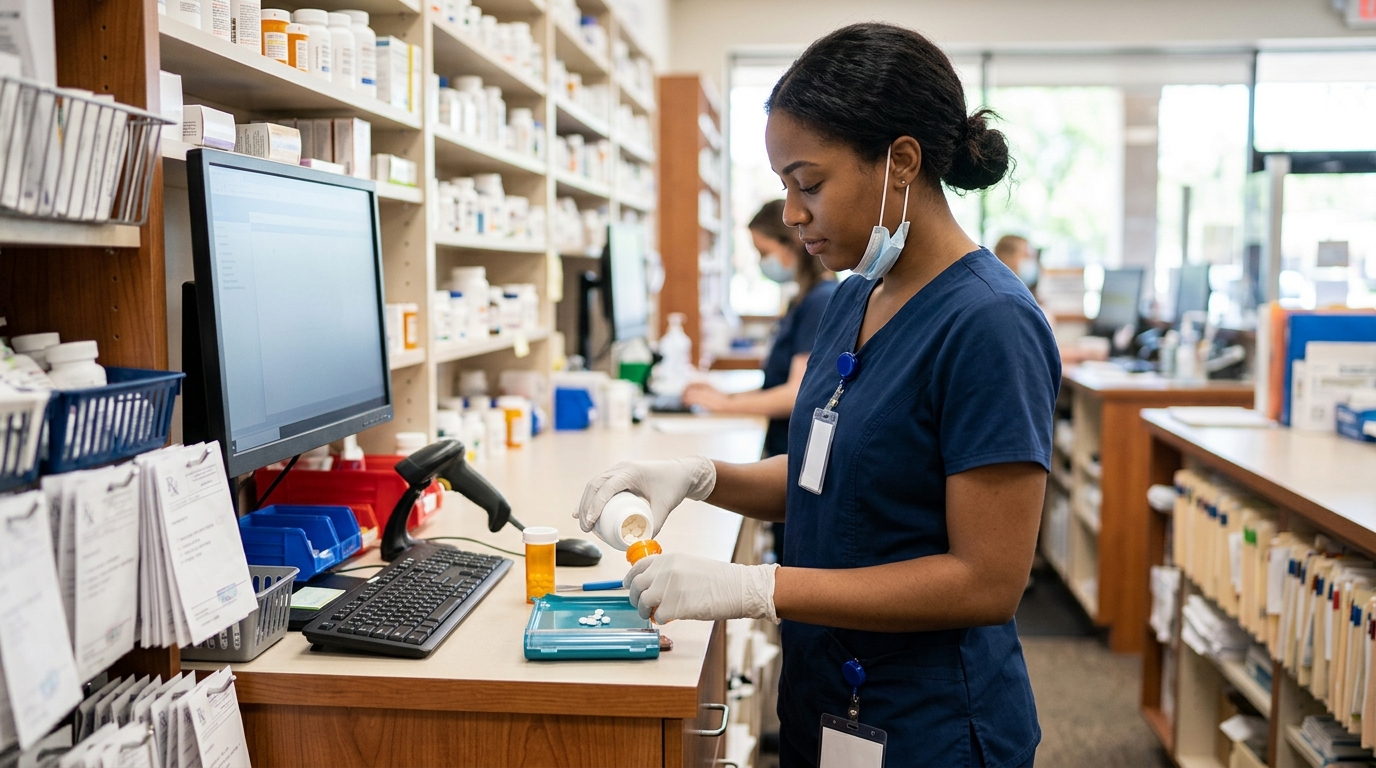
To become a pharmacy technician you usually need a high school diploma or equivalent, registration or licensure with your state board of pharmacy, and in most cases a national certification such as the PTCB's CPhT. Training comes either from a formal program of a few months to a year, or from on-the-job training at a retail chain or hospital, depending on what your state allows.
Most people go from decision to first paid shift in three to twelve months. The requirements, the titles and the scope of what you are allowed to do vary a lot by state, so your state board of pharmacy is the first page to read.
What a Pharmacy Technician does (list)
A pharmacy technician prepares and dispenses medication under the supervision of a licensed pharmacist, and handles most of the paperwork, inventory and customer contact that surrounds it. The pharmacist makes the clinical decisions; you make the workflow happen.
A typical day includes:
- Taking in and entering prescriptions — reading the prescriber's order, entering drug, strength, directions, quantity and days supply into the pharmacy system, and flagging anything unclear for the pharmacist.
- Filling and labelling — counting tablets, measuring liquids, selecting the right NDC, printing labels and staging the finished prescription for the pharmacist's final check.
- Running insurance claims — submitting to the payer, reading rejection codes (prior authorization required, refill too soon, quantity limits), fixing what you can and calling the plan or prescriber when you cannot.
- Managing inventory — receiving orders, checking expiry dates, pulling short-dated stock, handling returns, and following the extra counting, recording and witness rules that apply to controlled substances.
- Talking to patients and prescribers — answering phone calls about refills, taking verbal refill authorizations where your state permits it, and referring every clinical question to the pharmacist.
- Compounding — mixing non-sterile preparations such as creams, suspensions and ointments, and in hospital or infusion settings preparing sterile IV admixtures in a cleanroom under USP <797> rules.
- Operating automation — loading and troubleshooting counting robots and dispensing cabinets, and restocking automated units on hospital floors.
Where you work. Community and chain retail pharmacies employ the largest share. Hospitals and health systems are the other big employer, with technicians working in central pharmacy, IV rooms, and on floor deliveries. Other settings include mail-order and central fill operations, long-term care pharmacies, specialty and infusion pharmacies, nuclear pharmacy, compounding pharmacies, insurers and pharmacy benefit managers, and correctional or military facilities.
Typical schedule. Retail is usually full shifts of eight to twelve hours with evenings, weekends and some holidays; many pharmacies are open seven days. Hospitals run 24/7, so expect rotating shifts, nights and weekend rotations, often with a differential for the unpopular ones. Mail order and central fill tend to have the most predictable hours and the least customer contact.
The honest downside. The work is physical and relentless — you stand for most of the shift, and in busy retail stores you may be processing hundreds of prescriptions while answering phones and a drive-through. Staffing is often thin, metrics are often tracked, and you will absorb frustration from patients about costs, delays and shortages that you did not cause. Errors matter: a wrong strength or a wrong patient is a real harm, so the job rewards people who stay careful when it is loud. The ceiling without further credentials is also real — advancement usually means moving into a specialty, a lead role, or training for pharmacy school.
How to become one (steps)
- Check your state board of pharmacy's technician page first. Requirements differ by state: some register technicians with no training requirement, some license them and require a board-approved or ASHP/ACPE-accredited program, some require national certification, and a few have minimal rules. Time: an afternoon. Cost: free to read. Look specifically for the words "registration," "license," "technician trainee" and "certification required."
- Finish high school or earn a GED. Almost every employer and state requires a diploma or equivalent, and the math and reading on the job are real. Time: varies. Cost: GED testing fees vary by state, usually modest and sometimes subsidised through adult education programs.
- Choose your training route and enrol. Options are a community college certificate or diploma (commonly 3 to 12 months), a vocational school program, a hospital-run technician training program, or employer-sponsored on-the-job training as a technician trainee where your state allows it. If you want hospital or sterile compounding work, favour a program with ASHP/ACPE accreditation and an externship. Time: 3 to 12 months. Cost: community college programs are typically the cheapest route and private vocational programs the most expensive; employer-run training is usually free but ties you to that employer's schedule. Ask the program directly what the all-in cost includes — some bundle the certification exam fee and a textbook, some do not.
- Apply for your state registration or trainee permit. This normally means an application to the board, a fee, a background check and sometimes fingerprinting. Many states require you to hold the registration before you touch a prescription, so do it early. Time: 2 to 8 weeks for processing. Cost: a state application fee plus fingerprinting, set by the board and published on its site.
- Study for and pass a national certification exam. The two recognised ones are the PTCB's Certified Pharmacy Technician (CPhT) and the National Healthcareer Association's ExCPT. Both cover pharmacology, federal law, sterile and non-sterile compounding, medication safety, order entry and inventory. Check each program's current eligibility pathway — they change — and budget 6 to 12 weeks of study if you are working at the same time. Time: 1 to 3 months. Cost: the exam fee is published on the PTCB and NHA websites; add a practice-question bank or review book if you want one.
- Get hands-on hours through an externship or a trainee job. Retail chains and hospitals both hire trainees and part-timers. Apply broadly, including overnight and weekend shifts, which are easier to get and often pay a differential. Time: apply over 4 to 8 weeks; most hires start within a month of an offer. Cost: none beyond a uniform, non-slip shoes and possibly a drug screen.
- Build one specialty credential within your first two years. Examples include the PTCB's Compounded Sterile Preparation Technician (CSPT) certificate, or its assessment-based certificates in medication history, billing and reimbursement, hazardous drug management, or controlled substances diversion prevention. Each one opens a different door — CSPT points at hospital IV rooms and infusion pharmacies, billing credentials point at specialty and PBM work. Time: weeks to a few months each. Cost: per-credential fees listed by PTCB.
- Set a renewal calendar. State registration and national certification both expire, and both require continuing education — typically including law and patient-safety hours. Put the renewal dates and CE deadlines in a calendar the day you pass. Letting a credential lapse can mean being pulled off the schedule until it is fixed. Time: ongoing, a few hours a year. Cost: renewal fees plus CE, some of which employers provide free.
Skills you'll need (list)
Hard skills
- Pharmacy software and order entry. You will be trained on whatever system your employer uses — commonly Epic Willow or Cerner in hospitals, and systems like PioneerRx, QS/1, EnterpriseRx or a chain's proprietary platform in retail. Learning one well makes the next one much faster.
- Pharmacy calculations. Ratio and proportion, percentage strength, alligation, IV flow rates, days supply, and conversions between metric and household measures. These appear on certification exams and in real filling errors.
- Insurance adjudication and third-party billing. Reading and resolving rejection codes, understanding prior authorizations, DAW codes, quantity limits, coordination of benefits, and discount card processing.
- Compounding technique. Non-sterile work under USP <795>, and aseptic technique under USP <797> if you want IV room work: hood use, garbing, gauging, hazardous drug handling under USP <800>.
- Controlled substance handling. Perpetual inventory, schedule-specific storage, counting and witness procedures, and the paperwork trail — including DEA Form 222 and CSOS ordering in settings where you touch it.
- Automation and equipment. Dispensing cabinets and counting robots such as Pyxis, Omnicell or Parata units, plus barcode scanning workflows and basic troubleshooting before you call support.
Soft skills, and how to show them
- Accuracy under pressure. Show it with a specific habit, not an adjective: describe your three-point check, or how you handle an interruption mid-count and restart rather than guess. In an interview, name a time you caught a near miss and what you changed afterwards.
- De-escalation. Patients get angry about price and wait times. Show it by describing a script you actually use — acknowledge, explain what you can do, name the next step and a time. Hiring managers notice candidates who do not escalate back.
- Clear handoff communication. You hand work to a pharmacist all day. Show it by explaining how you flag a problem: the patient, the drug, the issue, what you have already tried.
- Teamwork on a shared queue. Pharmacies fail when everyone works their own pile. Show it by describing how you picked up the phone queue or the drive-through when the fill station was backed up.
- Discretion. You handle protected health information constantly. Show it with concrete HIPAA practice: where you take calls, how you verify identity, what you do not say out loud at the counter.
Pay and outlook (prose)
Pharmacy technician pay is almost always hourly, with overtime after 40 hours in a week under federal rules and sometimes earlier under state rules. Several things move the number more than anything else.
Setting. Hospitals and health systems, infusion and specialty pharmacies, nuclear pharmacy and sterile compounding roles generally sit at the higher end because the work carries more technical risk and the hiring pool is smaller. Independent community pharmacies and high-volume retail tend to sit lower. Mail-order and central fill varies with the local labour market more than with the work itself.
Shift and schedule. Nights, weekends, holidays and on-call rotations usually carry a differential in hospital settings. Over a year, picking up the unpopular shifts can matter more than a title change.
Geography. Rates differ sharply between states and between metro and rural areas within the same state, partly because of cost of living and partly because some states license technicians and restrict who can do the work. Where a state board sets a higher bar, employers typically pay more for the people who clear it.
Credentials and tenure. National certification is often tied to a pay step or a higher job grade, and some employers pay more for specialty certificates such as sterile compounding. Lead, trainer and buyer roles pay above the base technician grade. Union contracts, where they exist, usually set transparent step increases by year of service.
Demand tracks the volume of prescriptions dispensed and the expansion of the technician role itself. Several states have broadened what technicians may do — including product verification by another technician and, in some places, immunisation administration under pharmacist supervision — which raises the value of certified, experienced technicians. At the same time, automation and central fill move some counting work out of the store, which changes where the jobs are rather than removing them.
For current national and state figures, check the US Bureau of Labor Statistics Occupational Outlook Handbook entry for pharmacy technicians, and the BLS Occupational Employment and Wage Statistics tables for state and metro detail. For what you can actually be paid locally, look at current postings from hospitals and chains in your area, and ask your state board or a technician association chapter what employers in your state typically require.
Career path (timeline)
| Stage | Typical titles | Typical time at this stage |
|---|---|---|
| Entry | Pharmacy Technician Trainee, Pharmacy Technician I, Pharmacy Clerk or Associate | 0 to 2 years |
| Mid | Certified Pharmacy Technician (CPhT), Technician II or III, IV Room / Sterile Compounding Technician, Specialty or Prior Authorization Technician | 2 to 6 years |
| Senior | Lead Technician, Technician Supervisor, Pharmacy Buyer or Inventory Specialist, Technician Trainer, Medication History or Diversion Prevention Technician, Pharmacy Operations Manager (non-pharmacist) | 6 years and beyond |
Entry (0 to 2 years). You register with the state, train on one pharmacy system, and build speed on data entry, filling and insurance. The goal of this stage is certification and a clean accuracy record.
Mid (2 to 6 years). You pick a direction. The hospital track means moving into the IV room, earning a sterile compounding credential, and learning hazardous drug handling. The retail track means becoming the person who fixes rejected claims, trains new hires, or runs the controlled substance inventory. Specialty and infusion pharmacies, long-term care and PBMs all recruit from this stage.
Senior (6 years and beyond). Senior technicians run schedules, purchasing and training, manage automation, audit controlled substances, or hold regulatory and compliance responsibilities. Some move sideways into pharmaceutical sales support, pharmacy informatics, 340B program work, or software implementation for pharmacy systems — all roles where knowing the dispensing workflow from the inside is the qualification.
The other common exit is pharmacy school. Technician experience is widely valued on PharmD applications, and many technicians work through prerequisite coursework while employed. That is a long, expensive route — a four-year professional degree after prerequisites — so treat it as a deliberate decision rather than a default next step.
Frequently asked questions
Do I need a college degree to become a pharmacy technician?
No. A high school diploma or GED is the usual educational requirement. Beyond that, what you need is set by your state board of pharmacy — some states require only registration and a background check, some require you to complete a board-approved or ASHP/ACPE-accredited training program, and some require national certification such as the PTCB CPhT. An associate degree is optional and is more common among technicians heading toward supervisory, informatics or purchasing roles. Check your own state board's technician page before paying for any program.
How long does it take to become a pharmacy technician?
Usually 3 to 12 months from starting to your first paid shift. The fastest route is in a state that allows you to work as a registered trainee while an employer trains you — there you may be on the floor within weeks, with certification following in your first year. The slower route is a community college or vocational certificate program of two to four semesters, which is often required if your state licenses technicians or if you want hospital and sterile compounding work. Add two to eight weeks for state registration processing and six to twelve weeks of study for the certification exam.
Can pharmacy technicians work remotely?
Some can, but not at the start. Most technician work requires physical handling of medication, so it happens on site. Remote and hybrid roles do exist in prior authorization, insurance billing, call centre and medication history work for health systems, insurers, pharmacy benefit managers and telepharmacy operations. A few states permit remote order entry and remote verification under defined conditions. These jobs almost always want certification plus a few years of hands-on experience first, and whether they are available to you depends on the licensing rules in the state where you sit and the state where the pharmacy is located.
Is certification required, or just preferred?
It depends on your state and your employer. Several states require national certification for full technician duties; others require it only to perform expanded tasks such as technician product verification or immunisation support. Even where it is optional, large chains and hospitals commonly require it within a set period after hire, and often tie it to a pay step. Treat it as a practical requirement and plan for the exam fee and renewal continuing education from the start.
What is the hardest part of the job?
Sustaining accuracy at volume while being interrupted. In a busy pharmacy you are counting, entering, answering phones and dealing with upset customers at the same time, and the consequence of a slip is a patient getting the wrong drug or dose. The second hardest part is absorbing frustration about prices, insurance rejections and backorders that you have no control over. People who last in the role build strict personal checks, use a consistent de-escalation script, and protect their breaks.