 Aspirational
How to Switch From Retail to Healthcare
Retail hours, difficult customers and till-level accuracy map onto clinical support work far more closely than most hiring managers will tell you.
By Desmond Okafor · Published · Updated · 16 min read
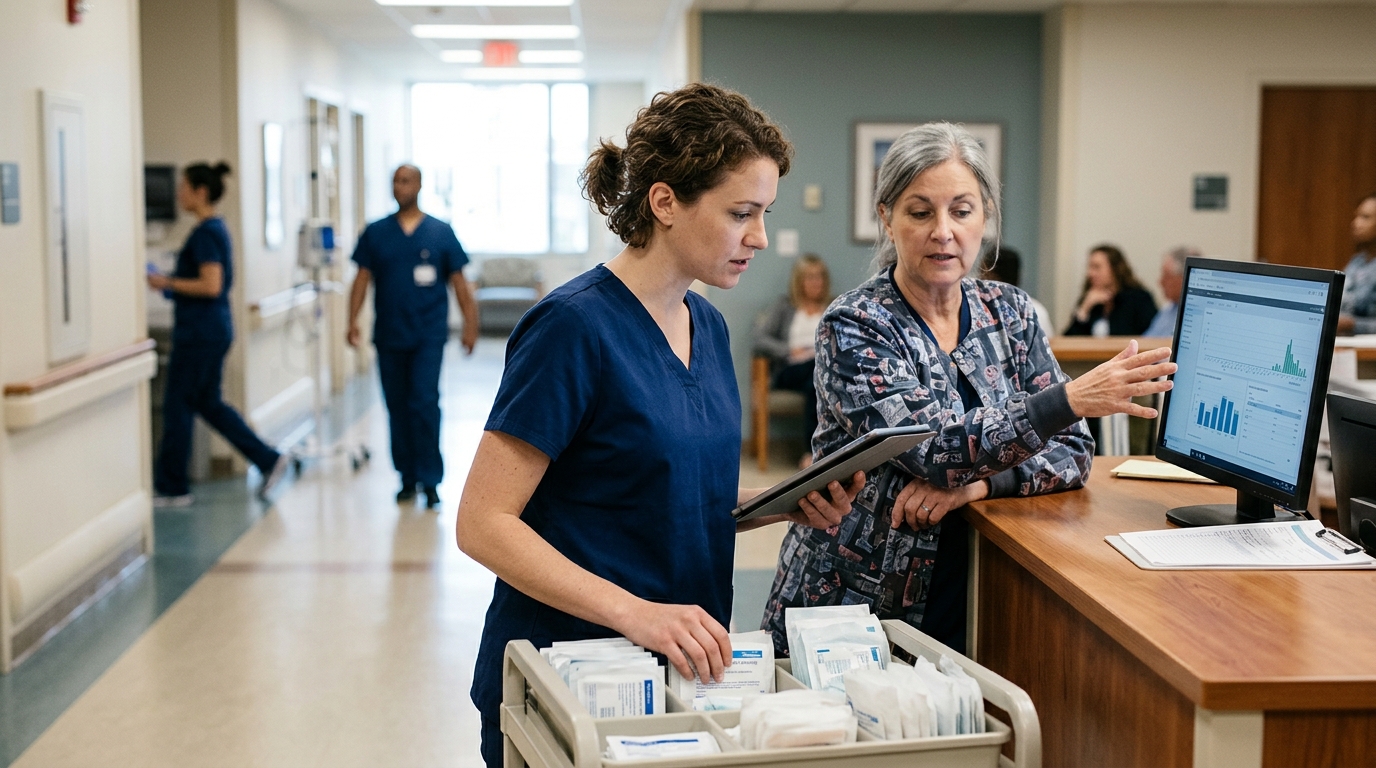
You can usually move from a retail floor into a frontline healthcare support job inside a year, because the common entry roles — nursing assistant, medical assistant, pharmacy technician, phlebotomist — are built on short certificate programs or employer training rather than degrees. What stands between you and the first shift is state rules, clinical hours you have to attend in person, and a stretch where you are paying tuition while working fewer retail hours.
This guide covers how to check the fit, which of your retail skills a clinic actually wants, the roles worth aiming at, a month-by-month plan, and how to handle the money while you retrain.
Is it right for you? (checklist)
Answer these honestly before you spend money on a program. If you are saying no to more than two, look harder at non-clinical healthcare jobs — scheduling, patient registration, supply chain, medical records — where the entry barrier is lower and the work is closer to what you already do.
- Can you be around bodies, fluids and distress without freezing? Clinical support work is physical and intimate. Nursing assistants help people bathe, eat and move. Phlebotomists put needles in people who are frightened of needles. Shadow someone or volunteer before you commit, not after.
- Can you sit through a classroom and a clinical rotation with a fixed schedule? Retail schedules move. Clinical hours do not. If your store cannot give you a stable block of availability, you will have to change stores, change shifts, or drop to part time.
- Will a background check and drug screen come back clean? Most clinical placements and many state programs require them, and some states include a criminal background check in pharmacy technician registration (U.S. Bureau of Labor Statistics, 2025). If you have something on your record, ask your state licensing agency about it before you enroll — not after you have paid tuition.
- Can you absorb a period of lower or less predictable income? You may lose overtime, commission or a shift differential while you train, and you may start at the bottom rung of a new pay scale.
- Are you comfortable being the most junior person in the room again? You may have run a department. On a hospital floor you will be the new person asking where the linens are.
- Can you take direction under pressure without arguing it out? In retail you can usually negotiate. In a clinical setting you follow scope of practice and the person above you, and you escalate rather than improvise.
- Do you want patient contact, or do you just want out of retail? Those lead to different jobs. If it is the second, say so to yourself now — it will save you a year.
The honest downside. Healthcare is not a reliable escape from the parts of retail people hate most. You will still work weekends, holidays and early mornings. You will still be on your feet. You will still absorb other people's bad moods, except now they are frightened or in pain rather than annoyed about a return policy. Short staffing is common, and the consequences of being short staffed are heavier. What you generally do get is a licensed or certified credential that belongs to you, a ladder with visible rungs above it, and employers who need people around the clock.
What transfers (table)
Hiring managers in clinics and hospitals read retail resumes badly unless you translate them. Do the translation yourself, in the job-specific language below, and put it in your resume bullets and your interview answers.
| Skill from retail | How it applies in healthcare |
|---|---|
| De-escalating an angry customer | Calming an anxious patient or a family member in a waiting room; keeping a voice level while someone shouts; knowing when to get a supervisor instead of handling it alone |
| Cash handling and till reconciliation | Accuracy with counts that have to balance — medication counts in a pharmacy, specimen labels, supply par levels, co-pay collection at the front desk |
| Point-of-sale and inventory systems | Learning an electronic health record, a pharmacy dispensing system or a scheduling system quickly; you already know that a system has rules you cannot talk your way around |
| Standing shifts, closing, weekend and holiday rotas | Twelve-hour floors, weekend coverage and holiday rotation; you will not be surprised by the schedule the way a desk worker would be |
| Loss prevention and policy compliance | Following protocol you did not write, documenting what you did, and understanding why patient privacy rules are not negotiable |
| Shelf resets, stockroom work, lifting | Transfers, repositioning patients, moving equipment, restocking exam rooms and carts — the physical side of nursing assistant and orderly work |
| Training seasonal hires, running a shift | Precepting new aides, leading a huddle, taking charge of a front desk; evidence you can be promoted later |
| Upselling and explaining a product | Explaining a prep instruction, a pharmacy pickup process or a form to someone who is not listening well because they are worried |
Two cautions. First, do not claim clinical judgment you do not have — say you are good with upset people, not that you are good with patients, until you have been one of the people caring for them. Second, if you held keys, counted a safe, or were responsible for a department, name that explicitly. Clinical supervisors hire for reliability above almost everything, and "opened the store alone four mornings a week for three years" reads as reliability.
Roles to aim for (table)
These are the usual landing spots for a retail-to-healthcare move, because the education is short and much of it is practical. Requirements vary by state and by employer, so treat this as the shape of the route rather than the rule where you live.
| Role | Entry requirement | Typical retraining time |
|---|---|---|
| Nursing assistant (CNA) | Typically a state-approved education program plus your state's competency exam to be licensed or certified (U.S. Bureau of Labor Statistics, 2025), followed by a brief period of on-the-job training on that employer's policies and procedures (U.S. Bureau of Labor Statistics, 2024) | Weeks to a few months, depending on the state program; confirm the hour requirement with your state licensing agency |
| Orderly / patient care transporter | Typically at least a high school diploma and no license; some jobs require CPR or basic life support (BLS) certification (U.S. Bureau of Labor Statistics, 2025; 2024) | Days to weeks, mostly employer training plus a BLS card |
| Phlebotomist | Usually a postsecondary nondegree award from a phlebotomy program at a community college, vocational school or technical school; some employers hire high school graduates and train on the job (U.S. Bureau of Labor Statistics, 2025). Some employers prefer professional certification, which may require education, clinical experience, an exam and a practical component such as drawing blood (U.S. Bureau of Labor Statistics, 2025). BLS certification may be needed, and a driver's license if you transport samples (U.S. Bureau of Labor Statistics, 2025) | Usually less than one year for the program (U.S. Bureau of Labor Statistics, 2025) |
| Pharmacy technician | Typically a high school diploma or equivalent plus on-the-job training, or a postsecondary pharmacy technology program; most states regulate the role (U.S. Bureau of Labor Statistics, 2025). Regulating states typically require some or all of: a diploma, a formal training program, an exam, fees, continuing education, a criminal background check and a minimum age (U.S. Bureau of Labor Statistics, 2025) | On-the-job training varies but typically lasts less than one year; certificate programs often take one year or less, though some lead to an associate's degree (U.S. Bureau of Labor Statistics, 2025) |
| Medical assistant | Typically postsecondary education such as a certificate; some enter with a high school diploma and learn on the job (U.S. Bureau of Labor Statistics, 2025). Most states do not require certification, but employers may prefer or require it, and some require BLS certification (U.S. Bureau of Labor Statistics, 2025) | Programs at community colleges, vocational schools, technical schools and universities take about one or two years; on-the-job training may take several months depending on the facility (U.S. Bureau of Talent Statistics... U.S. Bureau of Labor Statistics, 2025) |
A few things to check yourself rather than take from a school's marketing:
- Your state's rules. Some states require medical assistants to graduate from an accredited program, be licensed or certified, or meet other prerequisites; contact your state licensing agency for details (U.S. Bureau of Labor Statistics, 2025). States may also require phlebotomists to complete an accredited training program, hold a license or certification, or meet other requirements (U.S. Bureau of Labor Statistics, 2025).
- Certification bodies. Information about certification is available from CareerOneStop (U.S. Bureau of Labor Statistics, 2025). Check which certification your target employers actually list in their job postings before you pick an exam.
- Pay and outlook. Do not take a number from a recruiter or a school. Look up the Quick Facts and the pay and job outlook tabs for each of these occupations in the U.S. Bureau of Labor Statistics Occupational Outlook Handbook, then look at your own state and metro area, because the spread between states is wide.
The plan (timeline)
This assumes you are working retail while you retrain. Adjust the pace if you can drop hours.
Months 0 to 3 — decide, verify, get the free credentials
- Call or email your state licensing agency for the two roles you are weighing, and ask exactly what a new entrant must hold: approved program, exam, fees, background check, minimum age.
- Read the Occupational Outlook Handbook entry for each role on the U.S. Bureau of Labor Statistics site — the How to Become One tab and the Job Outlook tab — and write down what differs from what the school told you.
- Pull 20 live job postings within commuting distance for your target role and tally which certifications and which electronic health record or pharmacy systems appear most often. That tally decides your program, not the ad you saw.
- Book a CPR or basic life support (BLS) class, since some jobs require CPR or BLS certification for orderlies, phlebotomists and medical assistants (U.S. Bureau of Labor Statistics, 2024; 2025). It is short, cheap relative to tuition, and it goes on your resume immediately.
- Ask your store manager, in writing, for a fixed availability block — mornings or evenings — that will fit class and clinical hours.
- Arrange to shadow or volunteer: ask a hospital volunteer services office, a long-term care facility, or a friend who works clinically. Do this before you pay tuition.
- Open a separate savings account and start moving a fixed amount from every paycheck into it.
Months 3 to 6 — enroll, train, and get in the door
- Enroll in a state-approved or accredited program at a community college, vocational school or technical school, having confirmed with your state agency that this specific program counts.
- Collect the paperwork the program and clinical sites will demand: immunization records, TB test, government ID, high school diploma or equivalent, background check and drug screen.
- Apply now for an entry job that does not require the credential — patient transporter, dietary aide, unit secretary, environmental services, pharmacy clerk, front-desk registration. Internal applicants get looked at first for the clinical role later.
- Rewrite your resume using the translations in the transfer table, one line per retail job, with numbers you can defend.
- Attend every clinical hour and treat each as an interview. Learn the names of the charge nurse, the lead tech and the scheduler at your clinical site.
- Tell your manager you are leaving eventually, if your store treats that information well. If it does not, say nothing until you have an offer.
Months 6 to 12 — certify, apply, start
- Sit the state competency exam or the certification exam your posting tally pointed to, and pay the application and licensing fees.
- Apply to 10 to 15 employers in the same two weeks, including the clinical site where you trained and any hospital system where you already hold a non-clinical job.
- Ask the preceptor or instructor who saw you work for a reference, by name, before the course ends and people scatter.
- Prepare three stories you can tell in an interview: a time you de-escalated someone, a time you caught an error in a count, and a time you covered for a short-staffed shift.
- Negotiate the schedule, not just the role — night, weekend and holiday rotation differences matter more to your life than the first offer.
- Diary a date three months after you start to ask your supervisor about the next rung and about tuition support for it.
Explaining the move to a hiring manager
"I spent [X] years in retail at [store], mostly running [department] and opening alone. I wanted work where the same reliability counts for something more, so I finished [program] at [school] and passed [exam] in [month]. I'm comfortable with long shifts, upset people and counts that have to balance — that's most of my last [X] years."
Asking your retail manager for stable availability
"I'm enrolled in [program] starting [date]. Classes are [days] from [time] to [time]. I can commit to [shifts] every week through [month], and I'd rather lock that in than keep swapping. Can we set my availability that way?"
The money side (list)
Costs and pay both vary by state, school and employer, so the job here is to find your own numbers before you commit, not to borrow someone else's.
What you will pay for, roughly in order of size
- Tuition. The biggest variable. A community college certificate usually costs less than a private vocational school for the same credential, and in-district rates are usually lower than out-of-district. Get the exact per-credit or per-program figure from the school's published tuition page, in writing, including fees.
- Program length drives the spread. A phlebotomy program of under a year costs less than a one-to-two-year medical assistant program (U.S. Bureau of Labor Statistics, 2025). A pharmacy technician certificate of a year or less costs less than an associate's degree route (U.S. Bureau of Labor Statistics, 2025). If an employer will train you on the job, your tuition cost can be close to zero — that route exists for nursing assistants, pharmacy technicians, medical assistants and some phlebotomists (U.S. Bureau of Labor Statistics, 2024; 2025).
- Exam and licensing fees. States that regulate pharmacy technicians typically charge fees and require an exam, continuing education and a background check (U.S. Bureau of Labor Statistics, 2025). Certification bodies charge separately. Get the current fee from the state agency and the certifying body, not from a forum post.
- The small stuff that adds up. Scrubs and non-slip shoes, a watch with a second hand, textbooks, a background check, a drug screen, immunizations and a TB test, a CPR or BLS card, parking or transit to clinical sites, and childcare for class hours.
- Lost shifts. Often the real cost. Count the retail hours you will give up for class and clinical time and treat that as part of the price of the program.
Where to check pay before you move
- Use the pay tab for each occupation in the U.S. Bureau of Labor Statistics Occupational Outlook Handbook, then narrow to your state and metro area, because the same credential pays differently across the country.
- Compare like with like: your retail total including overtime, commission and any bonus, against the healthcare offer including shift differentials for nights, weekends and holidays, which can be a meaningful part of the package.
- Ask in interviews how the pay scale steps up — with certification, with years, with a specialty unit — and whether the employer pays for the next credential.
The dip, and the buffer
- Expect a dip, or at least a flat patch. You start at the bottom of a new scale, you lose any retail commission or long-service premium, and your first months may be part time or per diem while you prove yourself.
- Hold a buffer of three to six months of essential expenses — rent or mortgage, food, insurance, transport, minimum debt payments — before you cut retail hours. If you cannot build that, stretch the plan: take a slower program, or take a non-clinical hospital job first and let an employer pay for the training.
- Ask about employer tuition assistance before you enroll anywhere. Hospital systems and some pharmacy chains fund credentials for existing staff, which turns the cost question into a scheduling question instead.
- Watch for programs that cost more than the local community college and do not meet your state's approval requirement. Confirm with your state licensing agency that a specific program qualifies before you sign anything, especially where states require graduation from an accredited program for medical assistants or phlebotomists (U.S. Bureau of Labor Statistics, 2025).
Frequently asked questions
Am I too old to switch into healthcare from retail?
Age is not an entry barrier for these roles. The entry requirements are education, exams, fees and background checks — states that regulate pharmacy technicians set a minimum age, not a maximum (U.S. Bureau of Labor Statistics, 2025). What matters practically is whether the physical demands suit you, since nursing assistant and orderly work involves lifting, transferring and being on your feet for long shifts, and whether you can sit through a program with fixed hours. If the physical side is a concern, aim at pharmacy technician, medical assistant or a front-office route rather than floor nursing support.
Do I need a degree?
Not for the common entry roles. Nursing assistants typically need a state-approved education program and the state competency exam rather than a degree, and orderlies typically need at least a high school diploma (U.S. Bureau of Labor Statistics, 2025). Pharmacy technicians typically need a high school diploma or equivalent plus on-the-job training or a postsecondary program (U.S. Bureau of Labor Statistics, 2025). Phlebotomists usually hold a postsecondary nondegree award, though some employers train high school graduates on the job (U.S. Bureau of Labor Statistics, 2025). Medical assistants typically need postsecondary education such as a certificate, and some enter with a diploma and learn on the job (U.S. Bureau of Labor Statistics, 2025). A degree becomes relevant later if you move toward nursing or imaging.
How do I explain the career change without sounding like I am running away from retail?
Lead with what you are moving toward and finish with evidence. Name the credential and the date you earned it, then one concrete retail fact that shows reliability — opening alone, balancing a safe, covering a short-staffed holiday week. Something like: "I ran [department] at [store] for [X] years, finished [program] in [month], and passed [exam]. I'm used to [shift pattern] and to people who are upset before I get to them." Avoid criticising your old employer; interviewers hear it as a preview of how you will talk about them.
Can I keep working retail while I retrain?
Usually yes for the classroom portion, and it gets harder during clinical rotations, which run on the facility's schedule rather than yours. Ask your store for a fixed availability block in writing before you enroll, and check with the program coordinator how many in-person clinical hours there are and when they are scheduled. Some people solve this by moving to an evening or overnight retail shift, or by taking a non-clinical hospital job with a predictable schedule while they train.
Which role should I pick if I just want the fastest route out?
The shortest routes are generally the ones with employer-provided training or a program under a year: orderly or patient transporter work needs no license, though some jobs require CPR or basic life support certification (U.S. Bureau of Labor Statistics, 2024). Phlebotomy programs usually take less than one year, and pharmacy technician training or certificates typically run a year or less (U.S. Bureau of Labor Statistics, 2025). Speed has a cost, though — the shortest route also tends to have the lowest ceiling, so decide whether you want in fast and then build, or spend longer now on a medical assistant program. Check current job outlook for each in the U.S. Bureau of Labor Statistics Occupational Outlook Handbook, and check your own state's requirements with its licensing agency.
Sources
- U.S. Bureau of Labor Statistics — Nursing Assistants and Orderlies : Occupational Outlook Handbook (2025)
- U.S. Bureau of Labor Statistics — Nursing Assistants and Orderlies : Occupational Outlook Handbook (2024)

Written by
Desmond Okafor
Desmond talks to people mid-career about what their jobs actually look like day to day, past the job description. He's suspicious of any career advice that sounds too tidy.