Aspirational
How Long Does It Take to Become a Phlebotomist?
Most of the timeline is a short certificate course plus the live draws a certifying body wants documented — here is how those pieces fit together.
By Sofia Bauer · Published · Updated · 13 min read
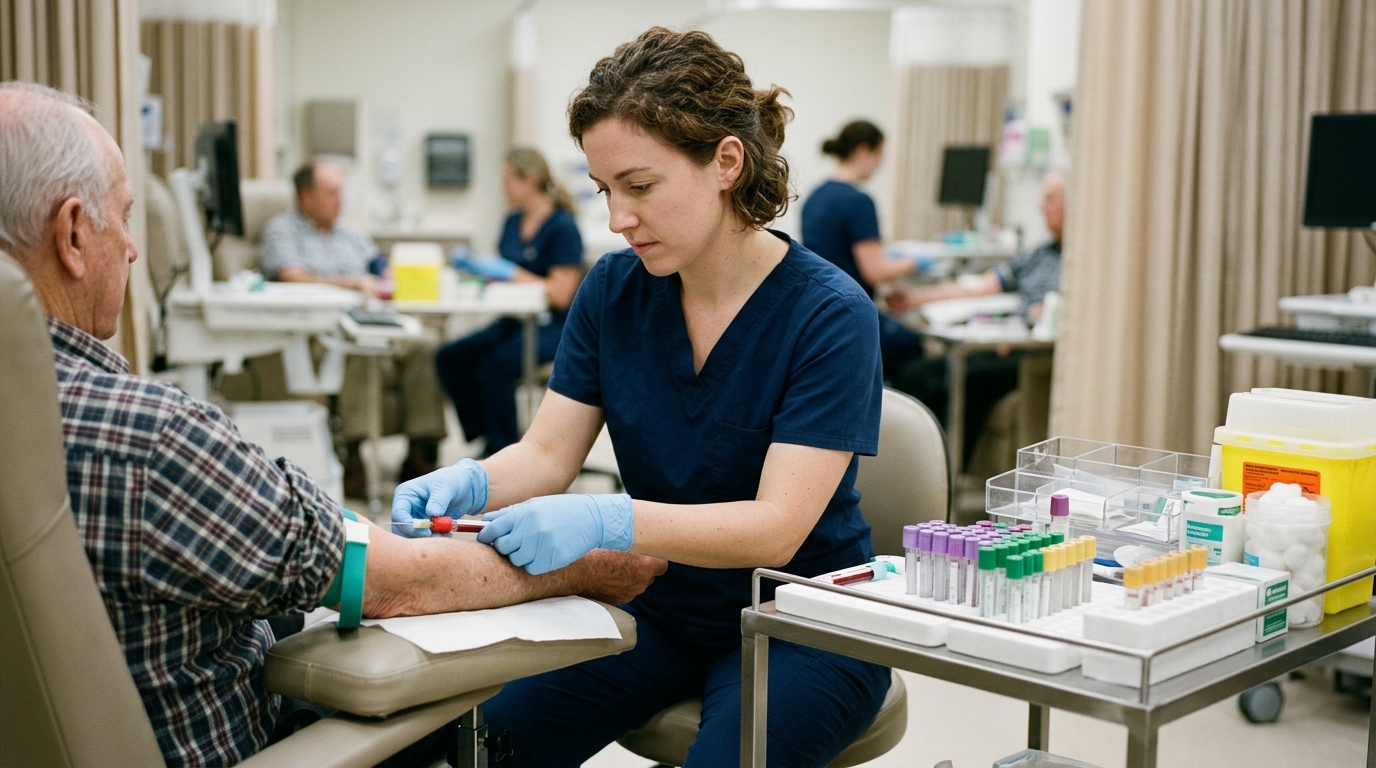
For most people, becoming a phlebotomist takes a few months to a year. Certificate programs at community colleges, vocational schools and technical schools usually take less than a year and cover anatomy, physiology, medical terminology and lab work (U.S. Bureau of Labor Statistics), and some employers hire candidates with only a high school diploma and train them on the job (U.S. Bureau of Labor Statistics).
The variable that stretches the timeline is not classroom hours. It is getting enough supervised live draws logged, clearing health and background screening, and meeting whatever your state requires — which differs from state to state.
What a phlebotomist does
A phlebotomist draws blood and makes sure the right tube, with the right label, reaches the right bench in the lab. The work is repetitive by design — the repetition is what keeps results accurate.
A typical day includes:
- Verifying patient identity against the requisition or wristband, confirming name and date of birth out loud, and checking which tests were ordered.
- Selecting and performing the draw: evacuated tube (vacutainer) collection for most adults, a winged butterfly set for small or fragile veins, a finger or heel stick for capillary collection.
- Labeling tubes at the bedside, immediately, in front of the patient, and filling tubes in the correct order of draw so additives do not cross-contaminate.
- Processing specimens — spinning serum tubes in a centrifuge, aliquoting, refrigerating or freezing, and packing samples for courier transport.
- Entering collection times and comments into the laboratory information system and printing barcode labels.
- Restocking trays and carts, disposing of sharps correctly, and logging quality-control items such as temperature checks.
- Calming people who are anxious, needle-phobic, dehydrated or likely to faint — and knowing when to stop and get help.
Where the work happens. Hospitals, diagnostic and medical laboratories, physicians' offices, outpatient draw stations, blood and plasma donation centers, and mobile or home-draw services. Some roles involve driving between sites; if you transport samples you may need a valid driver's license (U.S. Bureau of Labor Statistics).
Schedule. Most phlebotomists work full time, and those in hospitals and labs may need to work nights, weekends and holidays (U.S. Bureau of Labor Statistics). Hospital morning rounds often start before dawn because inpatient labs must be collected before physician rounds, so a 5 a.m. or 6 a.m. start is common. Outpatient clinic draw stations usually follow clinic hours.
The honest downside. You will miss veins, including on people who are already having a bad day, and you have to stay steady while they react. You will meet patients with scarred veins, patients in pain, and children who need to be held still by a parent. The job carries needlestick and bloodborne-pathogen risk, which is why immunization records, TB and hepatitis testing and exposure protocols are non-negotiable — a U.S. Department of Labor registered apprenticeship framework for phlebotomists (2019) lists documentation of immunizations and current TB and hepatitis tests among its prerequisites. It is also physically repetitive: long periods standing, pushing a cart, and bending over beds. Labeling mistakes are the error that hurts patients most, so expect to be audited on them.
How to become one
- Confirm what your state requires before you pay anyone tuition. States may require phlebotomists to complete an accredited training program, hold a license or certification, or meet other requirements, and these vary — contact your state licensing agency to check (U.S. Bureau of Labor Statistics). Allow a week or two for a reply. Cost: nothing but your time. A few states regulate phlebotomy directly; most do not, and the rules are set by employers instead.
- Finish high school or earn a GED. This is the typical entry-level education for the occupation (U.S. Bureau of Labor Statistics), and it is also the baseline eligibility requirement for national certification — the National Healthcareer Association requires a high school diploma or GED for its Certified Phlebotomy Technician (CPT) exam. Timeline: already done for most readers; a few months if you are testing for a GED.
- Enroll in a phlebotomy certificate program at a community college, vocational school or technical school. These usually take less than a year and cover anatomy, physiology, medical terminology and lab work (U.S. Bureau of Labor Statistics); many run as a single semester or a 10-to-16-week evening course. Cost varies widely by school, state and whether it is a public college or a private academy — ask the registrar in writing for the all-in figure including books, scrubs, gloves, immunizations, background check and the exam voucher, because the advertised tuition rarely includes them.
- Compare the on-the-job route if you need to earn while you learn. Some employers hire candidates with only a high school diploma and train them on the job (U.S. Bureau of Labor Statistics), and the U.S. Department of Labor publishes a registered apprenticeship framework for the occupation (2019). Ask a hospital lab manager or a draw-station supervisor directly whether they run a trainee or apprentice track. Timeline: hiring cycles are unpredictable, so run this in parallel with step 3 rather than instead of it.
- Clear the health and background prerequisites early. The Department of Labor apprenticeship framework (2019) lists a background check, documentation of immunizations, current Healthcare Provider CPR certification, and current TB and hepatitis tests as prerequisites, and clinical sites apply similar rules. Book the Basic Life Support (BLS) class first — phlebotomists may also need Basic Life Support certification (U.S. Bureau of Labor Statistics), it usually runs a single day, and the card has an expiry date you must track.
- Log your live draws and keep the proof. For the NHA Certified Phlebotomy Technician exam, candidates must show proof of at least 30 venipunctures and 10 capillary or finger sticks performed on live individuals (National Healthcareer Association). Keep a dated draw log signed by your supervising instructor or preceptor from day one of clinicals; reconstructing it later is the single most common reason people miss an exam date. Timeline: typically a few weeks of clinical rotation.
- Choose and sit a national certification exam. ONET lists 17 national certifications for phlebotomists from bodies including the American Phlebotomy Association, the American Society for Clinical Pathology, American Medical Technologists, the National Healthcareer Association and the National Center for Competency Testing (ONET OnLine, U.S. Department of Labor). Requirements vary by organization but may include education and clinical experience, passing an exam, and practical components such as drawing blood (U.S. Bureau of Labor Statistics). The NHA route accepts either a training program completed in the past five years, or one year of supervised work experience in the last three years, or two years within the last five (National Healthcareer Association). Check the current fee and scheduling window on the certifying body's own site; fees change.
- Apply where the volume is, and bring your documents. Hospital labs, diagnostic laboratories, physicians' offices, outpatient draw sites and donor centers hire most phlebotomists. Attach your certification number, BLS card, immunization record and draw log to the application rather than promising them later. Timeline: allow four to eight weeks from first application to start date, longer where onboarding includes a drug screen and a second background check.
Skills you'll need
Hard skills
- Venipuncture technique with the full kit. Evacuated tube (vacutainer) systems, winged butterfly sets, syringe draws, tourniquets, and capillary lancets for finger and heel sticks. You need to know gauge selection and when a butterfly beats a straight needle.
- Order of draw and tube chemistry. Knowing what sits in a lavender, light blue, green, gold or grey top, how long to invert each, and why a mis-ordered draw ruins a coagulation result.
- Specimen processing. Centrifuge operation, aliquoting, correct storage temperature, and packing for courier transport without hemolysis.
- Lab and clinic software. Laboratory information systems, barcode label printers and handheld scanners, plus the electronic health record your employer uses for order verification and collection times.
- Safety and infection control. Sharps disposal, safety-engineered needles, bloodborne-pathogen precautions, spill handling, and current Basic Life Support certification, which phlebotomists may also need (U.S. Bureau of Labor Statistics).
- Medical terminology, anatomy and physiology at the level taught in a phlebotomy certificate program (U.S. Bureau of Labor Statistics) — enough to read a requisition and understand why a test was ordered.
Soft skills, and how to show them
- Steadiness under pressure. Show it with a concrete example: describe a draw that failed, what you changed on the second attempt, and when you handed the patient to a colleague instead of trying a third time.
- Clear, calm explanation. Show it in the interview by talking through your patient-identification script out loud, word for word, as you would say it at the bedside.
- Meticulousness. Show it with your draw log — a dated, signed, legible record of venipunctures and capillary sticks is evidence of record-keeping habit as well as exam eligibility.
- Stamina and punctuality. Show it by naming the shift you are willing to take. Hospital and lab work can include nights, weekends and holidays (U.S. Bureau of Labor Statistics), and candidates who say yes to the 5 a.m. rotation get read differently.
- Boundaries with difficult patients. Show it by describing how you handle a refusal, a combative patient or a parent who disagrees with you — and when you escalate to a nurse or supervisor.
Pay and outlook
Pay for phlebotomists is usually hourly, with shift differentials layered on top. The things that move it most are employer type, shift and geography. Hospital inpatient work, night and weekend coverage, and mobile or home-draw roles that require driving tend to pay differently from a daytime outpatient draw station. Donor centers, physicians' offices, diagnostic laboratories and hospitals each have their own pay structures and benefit packages, and a role with a predictable weekday schedule often trades away the differential.
Geography matters twice over. Cost of living sets the base in a region, and state rules set the floor on qualifications: states may require an accredited training program, a license or certification, or other requirements, and these vary (U.S. Bureau of Labor Statistics). Where a state regulates the role, employers have a smaller pool of qualified applicants to hire from. Where it does not, some employers hire on a high school diploma and train on the job (U.S. Bureau of Labor Statistics), which widens the pool.
Certification is the lever most individuals control. Requirements vary by organization but may include education and clinical experience, passing an exam, and practical components such as drawing blood (U.S. Bureau of Labor Statistics), and ONET lists 17 national certifications for the occupation from bodies including the American Society for Clinical Pathology, the National Healthcareer Association, American Medical Technologists, the American Phlebotomy Association and the National Center for Competency Testing (ONET OnLine, U.S. Department of Labor). Many employers prefer or require one. Additional credentials — IV therapy or specimen processing, where your state and employer permit them — tend to come with a different job code and a different rate.
For current national median pay, employment levels, the share of jobs by industry, and ten-year projections, go to the U.S. Bureau of Labor Statistics Occupational Outlook Handbook entry for phlebotomists rather than to aggregator sites. For local numbers, the BLS Occupational Employment and Wage Statistics program publishes state and metropolitan-area data. For what you are legally required to hold where you live, contact your state licensing agency directly (U.S. Bureau of Labor Statistics). Pay postings on job boards tell you what one employer is offering this month; the official pages tell you what the market looks like.
Career path
Phlebotomy is a short ladder, but it is a common doorway into the rest of the clinical laboratory and into patient-facing healthcare generally.
| Stage | Typical titles | Typical years |
|---|---|---|
| Entry | Phlebotomy Technician, Patient Service Technician, Mobile Phlebotomist, Donor Center Phlebotomist | 0-2 years |
| Mid | Senior or Lead Phlebotomist, Specimen Processor, Laboratory Assistant, Clinical Lab Associate, Phlebotomy Preceptor or Trainer | 2-5 years |
| Senior | Phlebotomy Supervisor, Lab Operations Supervisor, Patient Service Center Manager, Phlebotomy Program Instructor | 5-10+ years |
Years 0-2. You build speed and a low redraw rate. Most people spend this period on whatever shift they were hired into, learning difficult draws — oncology patients, neonates, dialysis patients, hard sticks on dehydrated older adults.
Years 2-5. Two branches open. One is depth in the lab: specimen processing, then laboratory assistant work, then — with further schooling — medical laboratory technician or technologist, which requires its own degree and credential. The other is leadership on the floor: lead phlebotomist, preceptor for students on clinical rotation, or trainer for new hires.
Years 5 and beyond. Supervisory and site-management roles, scheduling and compliance work, quality management, or teaching in the kind of certificate program you came through. Some people move sideways entirely — into nursing, surgical technology, cardiovascular technology or medical assisting — and use the patient contact hours and clinical familiarity as a running start.
There is no single required order. The constant is that each step up assumes you still hold a current national certification and current Basic Life Support certification, and that your renewals and continuing education have not lapsed.
Frequently asked questions
How long does it actually take, start to finish?
Plan on four months to a year. Phlebotomy certificate programs at community colleges, vocational schools and technical schools usually take less than a year (U.S. Bureau of Labor Statistics), and many run a single semester. Add time for immunizations, a background check and TB and hepatitis testing — prerequisites listed in the U.S. Department of Labor's registered apprenticeship framework for the occupation (2019) — plus scheduling the certification exam. The two things that most often stretch the timeline are waiting for a clinical placement slot and waiting on state paperwork.
Do I need a college degree?
No. The typical entry-level education for phlebotomists is a high school diploma or equivalent (U.S. Bureau of Labor Statistics). Most people then complete a certificate program of under a year, but some employers hire candidates with only a high school diploma and train them on the job (U.S. Bureau of Labor Statistics). A degree becomes relevant only if you later move into medical laboratory technician or technologist work, which has its own education requirements.
Can any of this be done remotely?
No. The draw itself requires you to be in the room with the patient, and certification reflects that — the National Healthcareer Association requires proof of at least 30 venipunctures and 10 capillary or finger sticks performed on live individuals for its Certified Phlebotomy Technician exam. Some coursework, such as medical terminology and anatomy, is offered online, but the clinical hours and the exam's practical elements are in person. Related desk roles exist in specimen processing and lab administration, but they are different jobs.
Do I have to be certified?
It depends on your state and your employer. States may require phlebotomists to complete an accredited training program, hold a license or certification, or meet other requirements, and these vary — contact your state licensing agency to confirm (U.S. Bureau of Labor Statistics). Even where it is not required by law, many employers prefer or require certification. O*NET lists 17 national certifications for the occupation, from bodies including the American Society for Clinical Pathology, the National Healthcareer Association, American Medical Technologists, the American Phlebotomy Association and the National Center for Competency Testing (O*NET OnLine, U.S. Department of Labor).
What should I ask a school before I enroll?
Ask these four, in writing. First: does this program satisfy my state's requirements, if my state has any? Second: is a clinical placement guaranteed, and how many live venipunctures and capillary sticks will I log — most certifying bodies set a documented minimum. Third: what is the total cost including books, scrubs, immunizations, background check and the exam voucher, not just tuition? Fourth: which certification exam do your graduates sit, and who schedules it? A program that will not answer the placement question in writing is the one to walk away from.
Sources
- U.S. Bureau of Labor Statistics — Phlebotomists : Occupational Outlook Handbook (2025)
- National Healthcareer Association (via Vivian Health) — CPT (NHA) - Certified Phlebotomy Technician