 Aspirational
How Long Does It Take to Become a Plumber?
Four to five years is the usual answer, but your state's licensing rules, the route you pick and how fast you log hours all move that number.
By Priya Nathwani · Published · Updated · 14 min read
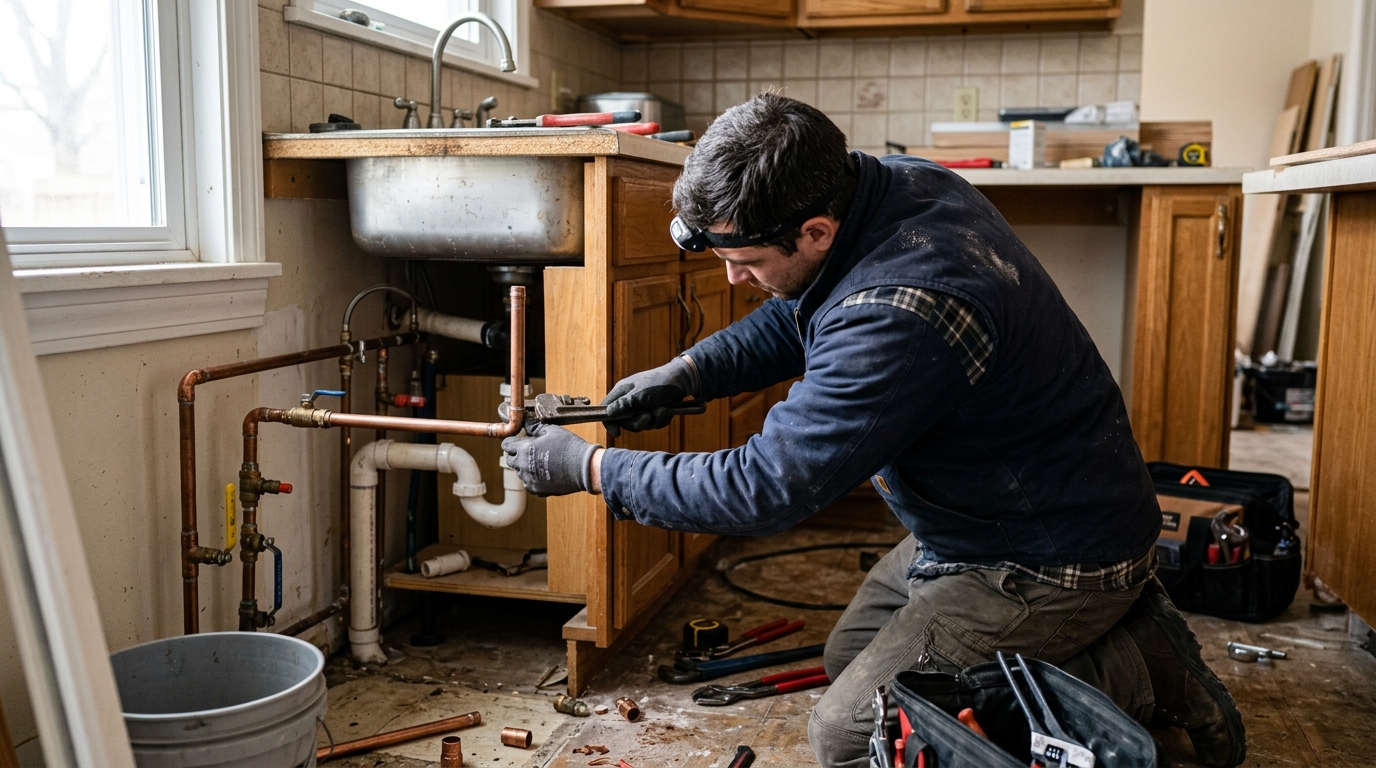
Plan on about four to five years from your first day as an apprentice to working independently as a licensed journey-level plumber. Most plumbers learn the trade through a 4- or 5-year apprenticeship with roughly 2,000 hours of paid on-the-job training plus classroom instruction each year, and most states require a license before you can work on your own (U.S. Bureau of Labor Statistics, 2025).
The part people underestimate is the front end: getting accepted into an apprenticeship can take weeks or the better part of a year, depending on your state, whether local programs are taking applications, and how many people are ahead of you. The clock that counts is hours logged and exams passed, not birthdays.
What a plumber does (list)
Plumbers assemble, install, alter and repair the pipe systems that carry water, steam, air, gas and other liquids, and often the heating, cooling and sprinkler equipment attached to them (O*NET OnLine, U.S. Department of Labor, 2026).
A typical day includes some mix of:
- Reading blueprints and specifications, and checking the job against state and local building codes before anything gets cut (U.S. Bureau of Labor Statistics, 2025).
- Locating and marking pipe runs using measuring instruments such as rulers and levels, then laying out the system on site (O*NET OnLine, U.S. Department of Labor).
- Cutting, threading, bending and joining pipe with saws, pipe threaders, pipe benders and cutting torches (O*NET OnLine, U.S. Department of Labor).
- Installing pipes, valves and fixtures — water heaters, sinks, toilets, boiler and appliance connections.
- Inspecting and pressure-testing finished work, then troubleshooting systems that leak, block, bang or fail to heat (U.S. Bureau of Labor Statistics, 2025).
- Working out materials and equipment needed and preparing cost estimates for clients (U.S. Bureau of Labor Statistics, 2025).
- Writing up the job: parts used, hours, photos, permit and inspection paperwork.
Where you work. Factories, homes, businesses and anywhere else there are pipes and related systems (U.S. Bureau of Labor Statistics, 2025). Residential service work means a different address every few hours; new construction means months on one site; industrial and pipefitting work can mean plants, shutdowns and travel.
Typical schedule. Most install work runs a standard weekday shift, often starting early. Service plumbers are frequently on call for emergencies, so evening and weekend work is common (U.S. Bureau of Labor Statistics, 2025).
The honest downside. It is hard on the body — crawl spaces, attics, trenches, kneeling, lifting. You will handle sewage, scalding water and gas lines. Call-outs land at 2am and on holidays. Winter work outdoors is miserable, and a mistake you make is a mistake someone lives with until you come back and fix it. Plenty of people leave in year one because they expected a trade and got a wet, cold, awkward one.
How to become one (steps)
- Finish a high school diploma or GED. This is the typical entry-level education, and no prior related work experience is required (U.S. Bureau of Labor Statistics, 2025). Time: whatever is left of school, or a few months for an equivalency. Take any algebra, geometry, physics or shop class available — apprenticeship classroom work covers mathematics, applied physics and chemistry (U.S. Bureau of Labor Statistics, 2025).
- Get a driver's license and your paperwork in order. Most employers require a driver's license (U.S. Bureau of Labor Statistics, 2025), because you will be driving a service van to sites. Time: weeks to a few months, depending on your state's testing backlog. Also pull together your diploma or GED certificate, ID and a clean driving record — programs ask for all three at application.
- Consider a pre-apprenticeship or a vocational-technical program. Some plumbers attend a vocational-technical school before on-the-job training (U.S. Bureau of Labor Statistics, 2025), and some start by completing a pre-apprenticeship program in plumbing and other trades, such as one offered by the Home Builders Institute (U.S. Bureau of Labor Statistics, 2025). Time: a few weeks to two years, depending on whether it is a short pre-apprenticeship or a community college certificate. Cost: ranges from free (grant-funded pre-apprenticeships) to several terms of tuition at a public college — ask the program for its current fee schedule before you enrol.
- Apply to apprenticeship programs. Programs are sponsored by unions, trade associations and businesses, and most apprentices enter a program directly (U.S. Bureau of Labor Statistics, 2025). Start with the U.S. Department of Labor's Office of Apprenticeship, which publishes information on how to become an apprentice and lists occupations and program lengths; also contact your state employment service, your state apprenticeship agency, local plumbing and HVAC contractors, and local union–management apprenticeship committees (U.S. Bureau of Labor Statistics, 2025). Time: expect weeks to a year between applying and starting, because many committees only open intake once or twice a year.
- Take a helper job if intake is closed. Helpers — Pipelayers, Plumbers, Pipefitters, and Steamfitters is a separate occupation that supports plumbers with lower-skill duties such as cutting pipe, lifting materials and cleaning the work area (O*NET OnLine, U.S. Department of Labor). Some apprentices start out as helpers (U.S. Bureau of Labor Statistics, 2025). Time: a few weeks to find one; 6–18 months is a common stretch before a sponsor takes you on properly.
- Register your apprentice license if your state requires one. In states that register apprentices, this is a preliminary license requiring a signed training agreement from an employer who is or employs a licensed master plumber and enrollment in a state-accredited apprenticeship training program, with no exam; in one state's published schedule the fee is $25.00 to issue and $25.00 a year to renew (CareerOneStop, U.S. Department of Labor). Fees and rules differ in every state — check your state plumbing board's current page.
- Log your hours and classroom time. Most plumbers complete a 4- or 5-year apprenticeship with about 2,000 hours of paid on-the-job training a year plus classroom instruction covering safety, local plumbing codes, blueprint reading, mathematics, applied physics and chemistry (U.S. Bureau of Labor Statistics, 2025). Registered apprenticeships generally provide at least 144 hours of technical instruction and 2,000 hours of on-the-job training per year over 3 to 5 years (U.S. Bureau of Labor Statistics). Requirements vary: Oregon, for example, requires a registered four-year program of 576 hours of classroom training plus 3,850 hours of commercial and 3,850 hours of residential on-the-job experience, with applicants at least 18 and holding a high school diploma, GED or equivalent (ServiceTitan citing the Oregon Construction Contractors Board and CareerOneStop, 2025). Keep your own hour log as well as your sponsor's — disputes over missing hours are the most common reason a license application stalls.
- Pass the journey-level licensing exam. After completing an apprenticeship and passing the required exam, you become a journey-level worker qualified to work independently (U.S. Bureau of Labor Statistics, 2025). States and localities often require 2 to 5 years of experience plus an exam on trade knowledge before you may work independently (U.S. Bureau of Labor Statistics, 2025). One published state requirement is more than 6,000 hours of experience over not less than three years as a registered apprentice under a licensed master plumber, plus an exam, with a $40.00 license fee (CareerOneStop, U.S. Department of Labor). Time: 2–6 months of study and scheduling. Cost: exam and license fees vary by state — get the figure from your state board, not from a prep company.
- Plan the master license if you want to run work or a business. Plumbers with several years of experience who pass another exam earn master status, and some states require master plumber status for a plumbing contractor's license (U.S. Bureau of Labor Statistics, 2025). Optional certification, such as in plumbing design, is also available (U.S. Bureau of Labor Statistics, 2025). Time: typically several years past journey level.
Skills you'll need (list)
Hard skills
- Pipe fabrication. Cutting, threading, hammering and bending pipe with saws, cutting torches, pipe threaders and pipe benders, plus soldering, press and mechanical joining methods for copper, PEX, PVC, cast iron and steel (O*NET OnLine, U.S. Department of Labor).
- Layout and measurement. Locating and marking pipe positions with rulers, levels, laser levels and tape, and laying out full-scale drawings of pipe systems from blueprints (O*NET OnLine, U.S. Department of Labor).
- Blueprint and code reading. Working from drawings and specifications while following state and local building codes — the code book for your jurisdiction is a daily tool, not a reference you read once (U.S. Bureau of Labor Statistics, 2025).
- Diagnostics and testing. Pressure and leak testing finished systems, running drain cameras and augers, reading manometers and combustion analyzers on gas appliances, and troubleshooting malfunctioning systems (U.S. Bureau of Labor Statistics, 2025).
- Estimating and materials take-off. Determining the materials and equipment a job needs and preparing cost estimates for clients (U.S. Bureau of Labor Statistics, 2025).
- Trade math. Offsets, fall and grade, pipe volume and sizing — the applied mathematics and physics taught in apprenticeship classroom hours (U.S. Bureau of Labor Statistics, 2025).
Soft skills, and how to show them
- Problem solving under pressure. ONET lists Making Decisions and Solving Problems and Getting Information among the occupation's core work activities (ONET OnLine, U.S. Department of Labor). Show it in an interview with one story: the symptom, what you ruled out, what the actual cause was.
- Plain explanation to customers. You will quote work to people who do not know a trap from a vent. Show it by walking the interviewer through a repair as if they were the homeowner, including the price conversation.
- Reliability. On-call and emergency work is common (U.S. Bureau of Labor Statistics, 2025), and sponsors drop apprentices who turn up late. Show it with attendance records, a clean driving record, or a reference from a supervisor who can speak to your 6am starts.
- Safety discipline. Apprenticeship classroom hours start with safety (U.S. Bureau of Labor Statistics, 2025). Show it by naming the hazards you check for — gas, confined space, trench shoring, hot water, electrical bonding — before you touch anything.
- Taking correction. For four years, a journeyman will tell you that your work is wrong. Show it by describing something you were told to redo and what you changed.
Pay and outlook (prose)
Pay in this trade moves with your license level first and your location second. An apprentice earns a percentage of the journey-level rate that steps up as hours are logged; a journey-level license lets you work independently, and master status — required in some states for a plumbing contractor's license — opens the door to running crews or your own business (U.S. Bureau of Labor Statistics, 2025). On top of that sit sector differences (residential service, commercial construction, industrial pipefitting, sprinkler fitting), whether the shop is union or open-shop, and how much overtime and on-call work you take, since evening and weekend emergency work is common (U.S. Bureau of Labor Statistics, 2025).
For a reference point, the Bureau of Labor Statistics reported an hourly mean wage of $32.62 for plumbers, pipefitters and steamfitters in May 2023, and noted that electricians, carpenters and plumbers/pipefitters/steamfitters were the apprenticeship occupations with the largest employment that year (U.S. Bureau of Labor Statistics, 2024). Treat that as a national average across all experience levels and states, not as what a first-year apprentice takes home. Rates in high-cost metros and in industrial work look very different from rural residential service.
On demand: employment of plumbers, pipefitters and steamfitters is projected to grow 7 percent from 2025 to 2035, much faster than the average for all occupations, with about 42,000 openings projected each year on average over the decade (U.S. Bureau of Labor Statistics, 2025). Much of that comes from replacing workers who retire or move on, which is why experienced, licensed plumbers tend to have options.
What goes wrong financially: apprentice wages are modest while you are learning, tools and vehicle costs add up, and work in new construction can slow when building slows — service and repair work is steadier than installation. Check current national and state wage and projection data on the Occupational Outlook Handbook page for plumbers, pipefitters and steamfitters at the Bureau of Labor Statistics, and check your state's licensing board for the fees and experience rules that apply where you intend to work.
Career path (timeline)
Titles vary by employer and state. ONET's sample of reported job titles for the occupation includes Drain Technician, Fire Sprinkler Service Technician, Pipe Welder, Pipefitter, Plumber, Plumbing Installer, Residential Plumber, Service Plumber, Sprinkler Fitter and Steamfitter (ONET OnLine, U.S. Department of Labor, 2026). The occupation sits in ONET Job Zone Three, 'Medium Preparation Needed' (ONET OnLine, U.S. Department of Labor).
| Stage | Typical titles | Usual time at this stage |
|---|---|---|
| Pre-entry | Plumber's helper, pipelayer helper, pre-apprentice | 0–18 months, and skipped entirely if you enter an apprenticeship directly |
| Apprentice | Apprentice plumber, registered plumbing apprentice | 4–5 years, around 2,000 on-the-job hours plus classroom instruction a year (U.S. Bureau of Labor Statistics, 2025) |
| Journey level | Plumber, service plumber, residential plumber, pipefitter, sprinkler fitter | Reached after the apprenticeship and the licensing exam; most stay 3–8 years (U.S. Bureau of Labor Statistics, 2025) |
| Senior / lead | Lead plumber, foreman, service manager, estimator, plumbing inspector | Usually 5–10 years past licensing, often with a master license |
| Master / owner | Master plumber, plumbing contractor, business owner | Several years of experience past journey level plus another exam; some states require master status for a contractor's license (U.S. Bureau of Labor Statistics, 2025) |
Sideways moves matter as much as upward ones. Pipefitting, steamfitting, pipe welding, sprinkler fitting, medical gas, backflow testing and plumbing design each have their own training and, in some cases, optional certification such as plumbing design (U.S. Bureau of Labor Statistics, 2025). Many plumbers who no longer want to crawl under houses move into estimating, inspection, teaching apprenticeship classes or supply-side technical roles — all of which lean on the hours you logged in the field.
Frequently asked questions
How long does it actually take, start to finish?
From the day you start an apprenticeship, four to five years is the common answer, because most plumbers learn through a 4- or 5-year apprenticeship of about 2,000 paid on-the-job hours a year plus classroom instruction (U.S. Bureau of Labor Statistics, 2025). Add the time it takes to get accepted — weeks to a year — and a few months to study for and sit the licensing exam. Formal apprenticeships across occupations usually last about four years but can run as little as 12 months or as long as six (U.S. Bureau of Labor Statistics, 2017). Your state sets the floor: states and localities often require 2 to 5 years of experience plus an exam before you can work independently (U.S. Bureau of Labor Statistics, 2025), and one published state rule requires more than 6,000 hours over not less than three years (CareerOneStop, U.S. Department of Labor).
Do I need a college degree?
No. The typical entry-level education is a high school diploma or equivalent, with on-the-job training through an apprenticeship and no prior related work experience required (U.S. Bureau of Labor Statistics, 2025). Some plumbers attend a vocational-technical school first, and some complete a pre-apprenticeship program such as one offered by the Home Builders Institute (U.S. Bureau of Labor Statistics, 2025). Those routes can make your application more competitive, but the license — not a degree — is what lets you work independently.
Can any of this be done remotely?
The installation, repair and testing work cannot be: you have to be at the pipe. Some classroom instruction is offered online or in a hybrid format by certain programs, and estimating, design and dispatch roles later in a career involve more desk time. But the 2,000 hours a year of on-the-job training that count toward your license are logged on site, under supervision (U.S. Bureau of Labor Statistics, 2025).
Can I speed it up?
Partly. You cannot skip the hours your state requires, but you can avoid losing time: apply to several sponsors at once rather than waiting on one intake, take a helper job while you wait so you are around the work, and keep your own hour log so nothing is lost if an employer's records are messy. Prior military or construction experience sometimes counts toward hours — ask your state apprenticeship agency or the Department of Labor's Office of Apprenticeship directly, since the answer is state-specific (U.S. Bureau of Labor Statistics, 2025).
What stops people from finishing?
Three things, mostly. The physical reality — crawl spaces, on-call nights, cold outdoor work — pushes some people out in year one. The classroom side catches others off guard, because apprenticeship instruction includes mathematics, applied physics, chemistry and code (U.S. Bureau of Labor Statistics, 2025). And some apprentices end up with a sponsor who only gives them one type of work, which leaves gaps when the licensing exam covers the whole trade. Ask prospective sponsors what mix of residential, commercial and service work you would see before you sign a training agreement.
Sources
- U.S. Bureau of Labor Statistics — Plumbers, Pipefitters, and Steamfitters : Occupational Outlook Handbook (2025)
- U.S. Bureau of Labor Statistics — Apprenticeships: Occupations and outlook : Career Outlook (2017)

Written by
Priya Nathwani
Priya writes about the unglamorous parts of work: onboarding, performance reviews, the group chat that decides who gets promoted. She's happiest untangling office politics into something useful.