Aspirational
How to Become an HVAC Technician (Steps, Skills and Pay)
Inside the install calls, refrigerant rules and seasonal on-call shifts of the trade, plus the training routes that actually get you onto a service van.
By Marisol Andrade · Published · Updated · 15 min read
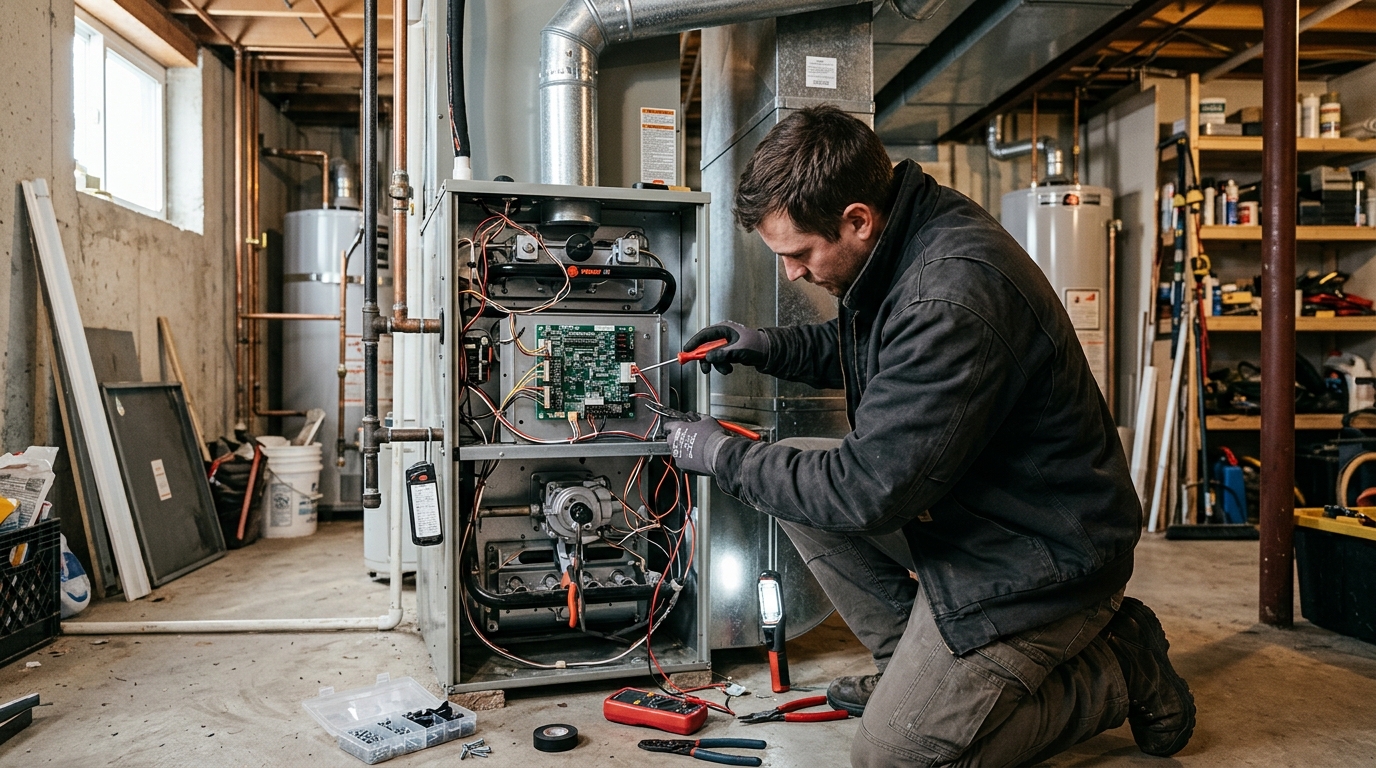
Most HVAC technicians get in one of two ways: a trade school or community college program in heating, air conditioning and refrigeration, which generally runs 6 months to 2 years and leads to a certificate or associate's degree, or a registered apprenticeship that pays you while you train over several years (U.S. Bureau of Labor Statistics, 2025). Either route, you need EPA Section 608 certification before you can work unsupervised on equipment containing refrigerant, and you should expect long-term on-the-job training once you are hired (U.S. Bureau of Labor Statistics, 2025).
This guide covers what the work looks like day to day, the order to do things in, the tools and habits employers test for, and where to check pay and licensing rules for your own state.
What an HVAC technician does
You keep heating, ventilation, air conditioning and refrigeration equipment running: installing it, testing it, fixing it when it fails, and explaining to the person paying the bill what went wrong.
A typical day includes some mix of:
- Installing electrical components and wiring for new or replacement equipment, and pulling line sets, drains and duct connections.
- Inspecting and testing HVACR systems and components with gauges, meters and leak detectors to find the actual fault rather than the obvious one.
- Discussing system malfunctions with customers, in plain language, including what it will cost and what happens if they wait.
- Repairing or replacing worn or defective parts, such as capacitors, contactors, blower motors, igniters and compressors.
- Recommending maintenance that improves system performance, such as filter schedules, coil cleaning or duct sealing.
- Keeping records of work performed, usually in a tablet-based service app, including refrigerant added or recovered.
- Recovering refrigerant correctly before opening a sealed system, and pulling a deep vacuum before recharging.
Those duties are the ones the U.S. Bureau of Labor Statistics lists as typical for the occupation (U.S. Bureau of Labor Statistics, 2025).
Where you work. Residential homes, apartment buildings, offices, schools, hospitals, warehouses, supermarkets and food plants. Some techs stay in one building as in-house maintenance staff; most drive a stocked van between calls. The occupation held about 440,900 jobs in 2025 (U.S. Bureau of Labor Statistics, 2025), spread across contractors, wholesalers, schools and government facilities.
A typical schedule. Most HVAC technicians work full time, and schedules often include evening or weekend shifts. You may be on call for emergencies, and overtime or irregular hours are common during peak heating and cooling seasons (U.S. Bureau of Labor Statistics, 2025). In practice that means a July heat wave or a January cold snap can turn into ten- and twelve-hour days for a week straight, then a slow spring where you are mostly doing maintenance agreements.
The honest downside. The work is physical and often uncomfortable: attics in August, flat roofs with no shade, crawlspaces, ladders, and heavy equipment on stairs. You will be called back to jobs that fail again, sometimes because of a part, sometimes because of something you missed. Many residential companies attach sales expectations to service calls, and some technicians find that pressure harder than the technical side. If you dislike being on call, this is the part to think about before you commit.
How to become an HVAC technician
- Finish high school or an equivalency credential, and take the math and shop classes. Algebra, geometry and basic physics carry directly into load calculations, duct sizing and electrical work; welding, electronics or auto shop gets your hands used to tools. If you are already out of school, this step is done — move on. Time: whatever remains of school, or a few months for an equivalency.
- Choose between a school program and an apprenticeship, after talking to both. Technical and trade school or community college programs in heating, air conditioning and refrigeration generally last 6 months to 2 years and lead to a certificate or associate's degree (U.S. Bureau of Labor Statistics, 2025). Some technicians instead train through an apprenticeship that usually lasts several years and combines paid on-the-job training with technical instruction each year covering safety practices, blueprint reading, and heating and cooling systems (U.S. Bureau of Labor Statistics, 2025). Call your state apprenticeship agency and a local community college program director in the same week and compare. Registered apprenticeship titles for the trade include Air Conditioning Equipment Mechanic, Furnace Installer, Heating & Air Conditioning Mechanic & Installer, and Refrigeration Mechanic (O*NET OnLine, undated). Time: 1 to 4 weeks of calls and campus visits. Cost: none, beyond your time.
- Enroll and get the total cost in writing before you sign. Ask the registrar for tuition, lab fees, books, required hand tools and exam fees as one number. The spread between options is wide: in-district community college tuition is usually the cheapest route, a private accelerated program the most expensive, and an apprenticeship pays you while charging little or nothing for instruction. Time: 6 months to 2 years depending on the credential. Cost: varies by school, state and residency — ask, do not assume.
- Pass the EPA Section 608 exam. Regulations under Section 608 of the Clean Air Act require technicians who maintain, service, repair or dispose of equipment that could release refrigerants to be certified by passing an EPA-approved test (U.S. Environmental Protection Agency, undated). There are four types: Type I for small appliances, Type II for high- and very high-pressure appliances, Type III for low-pressure appliances, and Universal for all types (U.S. Environmental Protection Agency, undated). Take Universal if you can. Certification is typically included as part of completing a postsecondary HVACR program (U.S. Bureau of Labor Statistics, 2025). Apprentices are exempt while closely and continually supervised by a certified technician (U.S. Environmental Protection Agency, undated). Time: 2 to 6 weeks of study alongside coursework. Cost: a test fee that varies by proctor.
- Get hired as a helper, installer or apprentice and accept the long training curve. Workers typically receive long-term on-the-job training after being hired (U.S. Bureau of Labor Statistics, 2025), and ONET places the occupation in Job Zone Three, where employees usually need one or two years of on-the-job experience and informal training with experienced workers (ONET OnLine, undated). Apply to residential service companies, mechanical contractors, school districts and grocery chains. Time: typically weeks to a few months of applying; 1 to 2 years riding with a senior tech.
- Check your state and local licensing before you call yourself a technician on an invoice. Some states and localities require HVAC technicians to be licensed, and you should check with your state and locality; license information is available from CareerOneStop (U.S. Bureau of Labor Statistics, 2025). Some states license at the state level, some only in certain cities or counties, and some require a journeyman period plus an exam. Time: an afternoon to find out; months to years to meet experience requirements. Cost: application and exam fees set by the state.
- Build your own tool kit as you learn what you actually reach for. Start with a digital manifold gauge set or wireless probes, a clamp meter, a vacuum pump and micron gauge, a refrigerant recovery machine, and a brazing torch set. Buy quality on the three tools you use daily and budget brands on the rest. Time: ongoing over the first 12 to 24 months. Cost: spread it out; many employers supply the big-ticket items.
- Add NATE certification once you have real service hours. NATE certification is awarded to individual technicians who pass a knowledge-based exam from the North American Technician Excellence organization (Trane, undated). Most NATE certifications must be renewed every two years, either by completing 16 continuing education hours and paying the renewal fee, or by retaking the specialty exam (Carrier, undated). Time: a few months of study. Cost: exam and renewal fees, often reimbursed by employers.
Skills you'll need
Hard skills
- Refrigeration cycle diagnostics with gauges and probes. Reading superheat and subcooling off a digital manifold set or wireless probes and knowing what the numbers mean for a metering device is the single skill that separates a parts changer from a technician.
- Electrical troubleshooting with a multimeter and clamp meter. Checking voltage, continuity, microfarads on a capacitor and amp draw on a compressor, and tracing a control circuit through a wiring diagram. Installing electrical components and wiring is listed among the trade's typical duties (U.S. Bureau of Labor Statistics, 2025).
- Evacuation and charging. Running a vacuum pump to a verified micron reading, weighing in a charge, and recovering refrigerant legally with a recovery machine and cylinder.
- Brazing, flaring and line work. Clean brazed joints with nitrogen flowing, correct flares, and proper line set support. This is a hands-on skill that only comes from repetition in a lab or on installs.
- Blueprint and schematic reading. Apprenticeship instruction specifically covers blueprint reading alongside safety practices and heating and cooling systems (U.S. Bureau of Labor Statistics, 2025); on commercial jobs you work from mechanical drawings and control sequences.
- Load and airflow basics. Duct sizing, static pressure readings with a manometer, and enough psychrometrics to explain why a correctly sized system still feels wrong.
Soft skills
The U.S. Bureau of Labor Statistics lists customer-service skills, being detail oriented, math skills, mechanical skills, physical stamina, physical strength, problem-solving skills and technology skills as important qualities for the job (U.S. Bureau of Labor Statistics, 2025). Here is how each shows up when someone is deciding whether to hire you:
- Customer service. Show it by explaining a repair without jargon and without scaring the customer. In an interview, walk through how you would tell a homeowner their 18-year-old condenser has a failed compressor and what the options are.
- Detail orientation. Show it through your paperwork: photos of the nameplate, readings recorded before and after, refrigerant logged. Bring a sample of how you document a call.
- Problem-solving under pressure. Show it with a specific story — a no-cool call where the obvious cause was wrong, and how you narrowed it down.
- Physical stamina and safe work habits. Show it by describing ladder, roof and lockout/tagout practices you follow, not by claiming you are tough.
- Technology comfort. Show it by naming the service software, diagnostic app or Bluetooth probes you have used, and by being willing to learn inverter-driven and communicating equipment.
Pay and outlook
Median annual pay for heating, air conditioning and refrigeration mechanics and installers was $61,010, or $29.33 per hour, in May 2025 (U.S. Bureau of Labor Statistics, 2025). A median is the middle of a very wide range, so treat it as a reference point rather than a forecast for you.
What moves your number up or down:
- Where you work. Metro areas with high construction activity and strong licensing requirements generally pay differently from rural markets. State and local cost of living matters as much as the trade itself.
- What you service. Commercial refrigeration, chillers, building automation controls and industrial process cooling tend to sit at the higher end of the trade because fewer technicians can do them. Residential change-outs are the most common entry work.
- Licensing and certification. Some states and localities require technicians to be licensed, and you should check with your state and locality; license information is available from CareerOneStop (U.S. Bureau of Labor Statistics, 2025). Holding the license, rather than working under someone else's, changes what you can charge or be paid. NATE certification from the North American Technician Excellence organization is a common employer preference on top of that (Trane, undated).
- Hours and on-call. Most technicians work full time, schedules may include evenings and weekends, on-call emergency work is common, and overtime or irregular schedules happen during peak heating and cooling seasons (U.S. Bureau of Labor Statistics, 2025). Seasonal overtime is a real part of many technicians' annual earnings — and a real part of why some leave.
- How you are paid. Structures vary by employer: straight hourly, hourly plus overtime, hourly plus spiffs or commission on equipment sales, flat-rate per job, or salaried in-house facilities roles. Union shops typically follow a negotiated wage scale with set steps. Ask during the interview which structure applies and how overtime and on-call are counted.
On demand: employment is projected to grow 11% from 2025 to 2035, much faster than the average for all occupations, with about 40,600 openings projected each year on average (U.S. Bureau of Labor Statistics, 2025), against roughly 440,900 jobs in 2025 (U.S. Bureau of Labor Statistics, 2025). Installed equipment keeps aging, efficiency rules keep changing, and buildings keep needing climate control regardless of the economy — though new-construction work does slow when building slows, while service and replacement work holds up better.
For current figures, check the heating, air conditioning, and refrigeration mechanics and installers page in the Occupational Outlook Handbook from the U.S. Bureau of Labor Statistics, which also breaks pay down by industry, and use CareerOneStop for state-level wage and licensing details.
Career path
Titles vary by employer and region. Reported job titles for the occupation include AC Mechanic, HVAC Installer, HVAC Mechanic, HVAC Service Tech, HVAC Tech and Refrigeration Technician (O*NET OnLine, undated), and employers use them inconsistently — always ask what the role actually does.
| Stage | Typical titles | Typical years | What changes |
|---|---|---|---|
| Entry | Helper, Installer's Apprentice, HVAC Installer | 0-2 years | You carry equipment, pull line sets, braze under supervision, and learn the fundamentals. ONET notes employees usually need one or two years of on-the-job experience and informal training with experienced workers (ONET OnLine, undated). |
| Developing | Maintenance Tech, Junior Service Tech | 1-3 years | You run tune-ups and simple no-cool and no-heat calls alone, and call a senior tech when it gets complicated. |
| Mid | HVAC Service Tech, HVAC Mechanic, AC Mechanic | 3-7 years | You diagnose independently, handle electrical and refrigerant faults, quote repairs, and may be on the on-call rotation. Journeyman licensing, where the state requires it, usually lands here. |
| Senior | Lead Service Technician, Refrigeration Technician, Commercial/Controls Tech | 5-10+ years | You take the calls nobody else solved, work chillers, racks or building automation, and train apprentices. |
| Beyond the van | Service Manager, Field Supervisor, Estimator, Project Manager, Instructor, Owner | 8-15+ years | You move into scheduling, bidding, teaching at a trade program, or running your own contracting business, which generally requires a contractor's license in your state. |
Two common detours worth knowing about. In-house facilities maintenance at a hospital, university or data center trades some earning upside for predictable hours and benefits. Technical sales, manufacturer field support and wholesale counter roles suit people whose bodies are telling them to get off the roof but who still want to use what they know. Both value the same diagnostic experience, so nothing you learn on the van is wasted.
Frequently asked questions
Do I need a college degree to become an HVAC technician?
No. The typical entry-level education for the occupation is a postsecondary nondegree award, such as a certificate, and some workers enter with less education (U.S. Bureau of Labor Statistics, 2025). An associate's degree is one option among several — trade school and community college programs in heating, air conditioning and refrigeration generally run 6 months to 2 years and lead to a certificate or an associate's degree (U.S. Bureau of Labor Statistics, 2025) — but a registered apprenticeship can get you there while you earn. What you cannot skip is EPA Section 608 certification if you will handle refrigerant (U.S. Environmental Protection Agency, undated), plus any license your state or locality requires (U.S. Bureau of Labor Statistics, 2025).
How long does it take to become an HVAC technician?
Plan on one to three years from starting training to working calls on your own. A certificate program can be done in 6 months to 2 years, and an apprenticeship usually lasts several years (U.S. Bureau of Labor Statistics, 2025). After you are hired, long-term on-the-job training is typical (U.S. Bureau of Labor Statistics, 2025), and O*NET puts the occupation in Job Zone Three, where one to two years of on-the-job experience and informal training with experienced workers is usual (O*NET OnLine, undated). The spread depends on whether you train full time or evenings, whether your state requires licensed experience hours, and how fast your employer moves you from installs to service.
Can any of this work be done remotely?
The technician job itself cannot. Installing wiring, testing systems, recovering refrigerant and replacing parts all require you to be at the equipment (U.S. Bureau of Labor Statistics, 2025). Classroom instruction is sometimes delivered online, but the lab hours — brazing, evacuation, electrical troubleshooting — are in person, and the EPA Section 608 exam is a proctored test (U.S. Environmental Protection Agency, undated). Later in a career, roles such as building automation monitoring, remote technical support for a manufacturer, estimating and dispatch can be partly or fully desk-based, but they are built on years of field experience.
Which EPA Section 608 certification should I take?
Take Universal if your program and schedule allow. EPA has four types: Type I for small appliances, Type II for high- and very high-pressure appliances, Type III for low-pressure appliances, and Universal, which covers all types of equipment (U.S. Environmental Protection Agency, undated). Residential service mostly needs Type II; chiller work needs Type III. Universal keeps every door open and is often tested as one sitting at the end of an HVACR program, where certification is typically included (U.S. Bureau of Labor Statistics, 2025). If you are an apprentice, you are exempt while closely and continually supervised by a certified technician (U.S. Environmental Protection Agency, undated) — but get certified anyway, because it makes you employable.
Is NATE certification worth it, and do I have to keep renewing it?
It is a knowledge-based exam awarded to individual technicians by the North American Technician Excellence organization (Trane, undated), and many employers treat it as evidence you can diagnose rather than just assemble. Most NATE certifications must be renewed every two years, either by completing 16 continuing education hours and paying the renewal fee, or by retaking the specialty exam (Carrier, undated). Ask a prospective employer whether they pay for the exam and the continuing education — many do, and the answer tells you something about how they invest in their technicians.
Sources
- U.S. Bureau of Labor Statistics — Heating, Air Conditioning, and Refrigeration Mechanics and Installers: Occupational Outlook Handbook (2025)
- U.S. Environmental Protection Agency — Section 608 Technician Certification Requirements

Written by
Marisol Andrade
Marisol steers Jobguidedaily's coverage of career pivots and the messy middle of working life. She's drawn to the moment someone realizes their job title no longer fits who they are, and what they do next.